
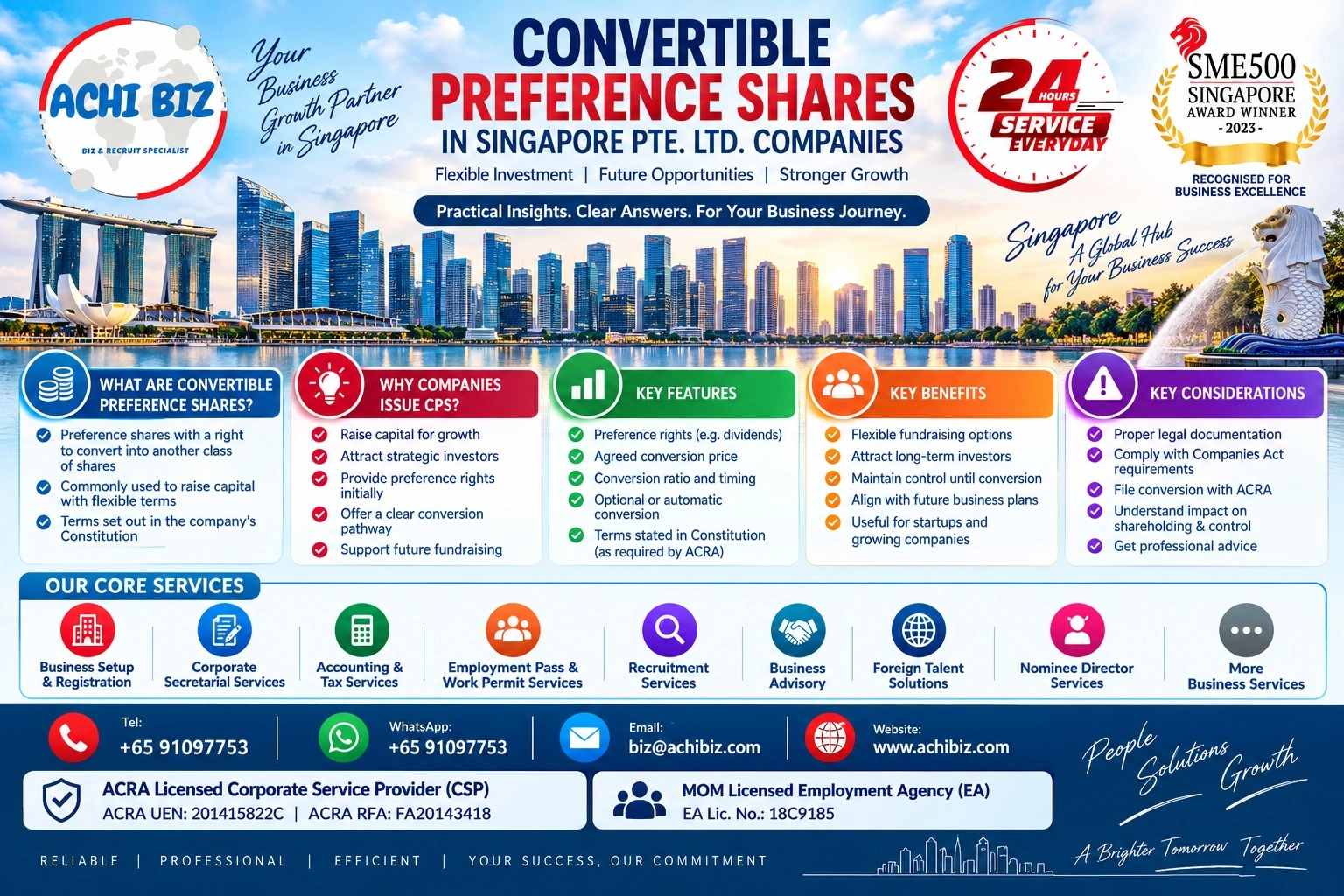
Convertible Preference Shares in Pte Ltd Companies – FAQ Guide
Convertible Preference Shares (“CPS”) can be a useful share-capital instrument for a Singapore private limited company where investors want preference rights initially, together with an agreed mechanism that allows the shares to be converted into another class of shares later.
ACRA recognises Convertible Preference Shares as one of the share types that Singapore companies may allot. Its current guidance describes them as preference shares that may provide fixed dividends for a period before conversion into ordinary shares at an agreed price or remain unchanged, and states that the relevant conversion prices must be set out in the company’s Constitution.
The real significance of CPS, however, lies in their terms. The conversion price, conversion ratio, timing, trigger events, investor rights before conversion, rights received after conversion, treatment of dividends and effect on the company’s future capital structure should be considered before the shares are issued.
This FAQ focuses specifically on Convertible Preference Shares in Singapore Pte. Ltd. companies. For the general characteristics of Ordinary Shares, Preference Shares and Redeemable Preference Shares, please refer to our separate ACHI BIZ articles. Treasury Shares will also be dealt with separately. The differences among these share types are best addressed in a dedicated comparison article rather than duplicated here. Refer to comparison of all types of shares in Pte. Ltd. companies in a detailed article separately.
Frequently Asked Questions About Convertible Preference Shares in Singapore
What are Convertible Preference Shares in a Singapore Pte. Ltd. company?
Convertible Preference Shares are preference shares carrying rights that allow or require them, according to their terms, to be converted into another class of shares.
In a typical structure, an investor initially holds preference shares with specified economic and governance rights. If the agreed conversion mechanism is subsequently triggered, those shares are converted into the class specified by the terms.
ACRA describes Convertible Preference Shares as a recognised share type and gives the example of preference shares that provide fixed dividends for a specified period before they may be converted into ordinary shares at an agreed price or remain unchanged.
The actual rights of any CPS issue must nevertheless be determined from the company’s Constitution and the specific terms governing the shares.
Are Convertible Preference Shares legally permitted in Singapore Pte. Ltd. companies?
Yes.
ACRA expressly recognises Convertible Preference Shares among the share types that companies can allot.
However, simply calling shares “Convertible Preference Shares” is not enough. The company must ensure that its Constitution, class rights, corporate approvals, allotment documents and subsequent conversion procedure properly support the intended structure.
Why would a Singapore Pte. Ltd. company issue Convertible Preference Shares?
CPS can help a company raise investment while giving investors a defined pathway to a different shareholding position later.
Depending on the commercial arrangement, companies may use CPS to:
- raise equity capital;
- attract private or strategic investors;
- structure early-stage or growth financing;
- provide preference rights during an initial investment period;
- establish a future conversion mechanism;
- accommodate different investment horizons;
- structure investment ahead of a future financing round;
- create predetermined conversion economics; or
- align an investor’s rights with future developments in the company.
The share structure should be chosen because it supports the company’s commercial objectives, rather than merely because CPS appear more sophisticated than a straightforward share issue.
Must the company’s Constitution provide for Convertible Preference Shares?
The Constitution is critically important.
Section 75 of the Companies Act 1967 provides that a company must not allot preference shares, or convert issued shares into preference shares, unless its Constitution sets out the holders’ rights concerning:
- repayment of capital;
- participation in surplus assets and profits;
- cumulative or non-cumulative dividends;
- voting; and
- priority of payment of capital and dividends relative to other shares or classes of preference shares.
ACRA additionally states specifically for Convertible Preference Shares that the conversion prices must be stated in the company’s Constitution.
Accordingly, the Constitution should be reviewed before CPS are issued.
What happens if the Constitution does not properly state the rights of the preference shares?
This can amount to statutory non-compliance.
Under section 75(2) of the Companies Act, where the company fails to comply with section 75, the company and every officer in default may be liable on conviction to a fine not exceeding S$2,000.
The preference-share provisions should therefore not be treated as optional drafting details.
What should be stated in the terms of Convertible Preference Shares?
The precise drafting depends on the transaction, but a properly structured CPS arrangement may need to address matters such as:
- issue price;
- dividend rights;
- whether dividends are cumulative or non-cumulative;
- voting rights;
- capital and liquidation rights;
- conversion price;
- conversion ratio;
- conversion period;
- who may initiate conversion;
- whether conversion is optional or automatic;
- events triggering automatic conversion;
- treatment of accrued rights;
- treatment of fractional shares;
- adjustments following changes in capital structure;
- consequences of future share issues;
- post-conversion share rights; and
- procedural requirements for conversion.
Ambiguity at the time of issue can become a serious problem when conversion is later requested or triggered.
What is a conversion price for Convertible Preference Shares?
The conversion price is part of the economic mechanism used to determine the shares that an investor receives upon conversion.
ACRA’s current guidance specifically states that conversion prices must be stated in the company’s Constitution.
This is particularly important because the conversion price can directly influence how much of the company the investor will hold after conversion.
What is a conversion ratio?
A conversion ratio determines how many shares of the resulting class are received for the CPS being converted.
For example, the commercial terms might establish a one-for-one conversion or another agreed formula.
The conversion ratio should not be considered in isolation. It may interact with the conversion price and any contractual adjustment mechanism.
Can CPS convert on a one-for-one basis?
They can potentially be structured that way where the agreed terms provide for it.
However, there is no reason to assume that every CPS automatically converts one-for-one.
The actual conversion mechanics must be determined from the Constitution and the applicable CPS terms.
Can the conversion ratio change over time?
The terms can potentially contain adjustment mechanisms.
For example, parties may negotiate provisions addressing certain future corporate events or changes to the company’s capital structure.
Because such provisions can materially affect both existing shareholders and the CPS investor, complex adjustment formulas should be professionally drafted and reviewed.
Can the investor choose whether to convert the CPS?
Potentially, if the terms grant the investor an optional conversion right.
The important point is that the answer comes from the CPS terms, not merely from the word “convertible”.
The documentation should make clear:
Who can trigger conversion?
When can they do so?
What conditions must be satisfied?
What happens after the conversion notice is given?
Can the company decide when CPS will be converted?
Potentially, if the terms validly provide the company with that right.
However, a company-controlled conversion mechanism can have significant consequences for the investor. The circumstances in which the company can exercise the right should therefore be clearly drafted.
Can Convertible Preference Shares convert automatically?
A CPS structure can potentially include an automatic conversion mechanism triggered by a defined event.
Possible commercial triggers might include a specified financing event, an agreed date or another clearly defined corporate event.
The trigger should be objectively identifiable. Poorly drafted triggers can create disputes over whether conversion has actually occurred or should have occurred.
Can CPS have both optional and automatic conversion mechanisms?
Potentially, yes.
For example, terms might give the investor an optional conversion right during one period while providing for automatic conversion if a specified future event occurs.
Where multiple conversion mechanisms coexist, their interaction should be carefully drafted so that the company can determine which provision takes priority.
Can CPS remain unconverted?
Depending on the terms, yes.
ACRA’s description itself contemplates Convertible Preference Shares that may be converted into ordinary shares at an agreed price or left unchanged.
This highlights why investors should not assume that “convertible” necessarily means conversion must occur.
Is conversion guaranteed merely because the shares are called Convertible Preference Shares?
No.
“Convertible” identifies an important feature of the shares, but the circumstances under which conversion may or must occur depend on their terms.
The investor should therefore understand the conversion trigger, timing, conditions and procedure before subscribing.
When should the conversion terms be agreed?
Preferably before the CPS are issued.
Leaving fundamental conversion economics to future negotiation defeats much of the purpose of using a structured convertible instrument.
The company and investor should know from the outset how the conversion mechanism is intended to operate.
Can the conversion price be fixed in advance?
ACRA contemplates conversion at an agreed price and requires conversion prices to be stated in the Constitution.
The precise commercial mechanism can therefore be structured upfront, subject to applicable law and proper drafting.
Can a conversion formula be used instead of a simple fixed ratio?
Sophisticated investment arrangements may use formulas rather than a simple one-for-one mechanism.
However, the more complex the formula, the greater the need for clarity.
The documentation should enable the company, investor, company secretary and professional advisers to calculate the resulting shareholding objectively when conversion occurs.
What happens to the investor’s preference rights after conversion?
This is a critical structural question.
Conversion changes the shares from one class into another. The holder’s rights after conversion will therefore depend on the rights attached to the resulting class rather than simply continuing all the rights previously attached to the CPS.
ACRA defines share conversion as changing existing shares into a different class or type of shares.
The investor should therefore understand both:
the rights held before conversion, and
the rights that will apply after conversion.
Does conversion mean the investor receives cash from the company?
Not ordinarily as the essence of the conversion itself.
Share conversion changes the existing shares into another class of shares. ACRA describes conversion precisely in those terms.
Accordingly, conversion should not be confused with a cash exit mechanism.
Does converting CPS mean that the shareholder is selling the shares?
No.
A conversion is a change in the class or type of the existing shares. It is not, merely by reason of conversion, a transfer of those shares from the existing shareholder to another person.
ACRA treats share conversion and share transfer as separate share transactions with different filing procedures.
Is conversion of CPS the same as issuing completely new shares?
Not necessarily.
ACRA defines conversion as changing existing shares into a different class. This is distinct from an allotment of new shares.
However, the precise capital consequences and filings should be reviewed for the actual transaction.
Can CPS conversion affect the ownership percentage of shareholders?
Yes, potentially.
The resulting shareholding structure may change materially when CPS convert.
The company should therefore prepare a fully diluted or post-conversion cap table before agreeing to the CPS terms, particularly where a substantial investment is involved.
Why is a post-conversion cap table important?
Because the commercial effect of CPS may not be obvious from the pre-conversion shareholding percentages.
A cap-table analysis can help identify:
- resulting ownership percentages;
- changes in voting influence;
- effects on founders;
- effects on existing investors;
- consequences for different share classes; and
- implications for subsequent fundraising.
The conversion mechanism should therefore be modelled numerically rather than understood only from legal wording.
Can CPS conversion dilute existing shareholders?
Potentially, depending on the company’s existing share structure and the conversion terms.
The economic effect should be modelled before CPS are issued.
Existing shareholders should understand not merely how many CPS are being issued today, but also what the company’s capital structure may look like after conversion.
Can CPS affect founders’ future ownership?
Yes.
A founder may retain a particular ownership percentage when the CPS are first issued but have a different percentage once the conversion mechanism is exercised.
For startups and growth companies, modelling the post-conversion position is therefore particularly important.
Can conversion affect voting control?
Potentially.
This depends on the rights attached to the CPS before conversion and the rights attached to the resulting shares afterward.
A conversion may therefore have governance consequences in addition to economic consequences.
Can CPS affect future fundraising?
Yes.
A future investor will generally want to understand the company’s existing capital structure and outstanding rights capable of affecting future ownership.
CPS can influence:
- the fully diluted cap table;
- future ownership percentages;
- investor negotiations;
- valuation discussions;
- available share classes;
- shareholder approval dynamics; and
- transaction documentation.
A company planning future fundraising should therefore keep complete records of all CPS terms.
Can CPS be useful in startup fundraising?
Yes, where the structure suits the transaction.
CPS can allow an investor to obtain negotiated preference rights at the investment stage while also having a mechanism for conversion under agreed circumstances.
However, a startup should consider whether the additional legal, accounting and administrative complexity is justified by the investment being raised.
Can established private companies also issue CPS?
Yes. CPS are not exclusively a startup instrument.
An established private company may consider CPS for strategic investment, family investment arrangements, corporate restructuring or other legitimate financing objectives.
The suitability depends on the transaction rather than the company’s age.
Can CPS be issued to an individual investor?
Potentially, yes.
Singapore companies can have individual shareholders, and CPS may be issued to an individual where the company’s Constitution, approvals and transaction terms support the allotment. ACRA confirms generally that shareholders can include individuals and corporate entities.
Can CPS be issued to a corporate shareholder?
Potentially, yes.
A corporate entity can generally be a shareholder in a Singapore company. The CPS structure should nevertheless be reviewed in light of the particular investment and the investor’s circumstances.
Can a foreign investor hold Convertible Preference Shares in a Singapore Pte. Ltd. company?
Singapore private companies can generally have foreign shareholders, subject to any specific regulatory restrictions applicable to the company’s activities or transaction.
Where a foreign investor is involved, additional tax, regulatory, beneficial-ownership, KYC and cross-border considerations may need to be reviewed.
Do CPS automatically pay fixed dividends?
Not simply because they are called convertible preference shares.
ACRA uses fixed dividends for a specified period as a typical description of CPS, but the actual dividend rights must be established by the company’s Constitution and applicable terms.
Section 75 also requires the Constitution to address whether preference-share dividends are cumulative or non-cumulative.
Can CPS dividends be cumulative?
The terms of a preference-share class can address cumulative or non-cumulative dividends, and section 75 requires those rights to be stated in the Constitution.
Whether a particular CPS issue should have cumulative dividends is a commercial structuring decision.
What happens to unpaid or accrued dividends when CPS convert?
This should be addressed expressly in the CPS terms.
Possible structures may treat accrued entitlements differently. Leaving the matter silent can create disputes at conversion.
The documentation should therefore explain whether and how any accrued dividend entitlement is dealt with when conversion occurs.
Do CPS automatically carry voting rights?
No automatic assumption should be made.
Section 75 requires the Constitution to specify the voting rights of preference shareholders.
The CPS terms should also make clear how the voting position changes upon conversion.
Can CPS holders have special consent or protective rights?
Investment arrangements can potentially include negotiated consent or protective provisions, subject to the Companies Act, Constitution and proper drafting.
Such provisions should be distinguished from the ordinary statutory or class voting rights attached to the shares.
Where substantial investor veto or consent rights are proposed, professional legal advice is advisable because these rights can materially affect company governance.
Must directors obtain shareholder approval before issuing CPS?
The general statutory rules governing the issue of shares apply.
Section 161 of the Companies Act provides that directors must not exercise the company’s power to issue shares without prior approval of the company in general meeting. The approval may relate to a specific issue or operate generally, subject to the statutory framework.
The company’s Constitution and existing shareholder arrangements should also be reviewed before allotment.
Should pre-emption rights be checked before issuing CPS?
Yes, where relevant.
An issue of CPS can affect existing shareholders economically and potentially affect future ownership upon conversion. The company’s Constitution, applicable statutory framework and shareholders’ agreements should therefore be reviewed for any pre-emption provisions or other restrictions before the issue proceeds.
For detailed analysis of Pre-emption Rights in Singapore Pte. Ltd. companies, refer to our separate ACHI BIZ articles on that subject rather than duplicating that discussion here.
Does the company need to file the initial allotment of CPS with ACRA?
The issue of new shares generally requires the applicable allotment filing with ACRA.
ACRA’s current share-transaction guidance identifies the Return of Allotment of Shares as the filing used when a company issues new shares.
The class and rights should be properly established before the allotment is filed.
Does CPS conversion need to be notified to ACRA?
Yes.
ACRA states that when a company converts existing shares into a different class, it must file a conversion of shares to notify ACRA.
This is a distinct corporate filing and should not be confused with an allotment, transfer, redemption or alteration of share capital.
Who can file a share conversion with ACRA?
ACRA states that company officers such as a director or company secretary can file directly.
The company may also engage a Corporate Service Provider (CSP) to file on its behalf.
Is there an ACRA filing fee for conversion of shares?
ACRA’s current guidance states that the conversion-of-shares filing is free, with immediate approval processing.
Companies should check the prevailing ACRA requirements when the actual transaction occurs because eService procedures can change.
How is a share conversion filed with ACRA?
ACRA currently directs companies to use the Update shares information eService in Bizfile and select File conversion of shares.
The company should first ensure that the underlying corporate transaction and supporting documents are correct before making the filing.
When does conversion take effect for a Singapore private company?
This is particularly important.
Section 74A(4) of the Companies Act provides that a conversion of shares by a private company does not take effect until the company’s Electronic Register of Members is updated by the Registrar under section 196A(5).
Companies should therefore distinguish between approving a conversion, filing it and the point at which the conversion legally takes effect.
Why is the Electronic Register of Members important when CPS are converted?
For a private company, the Electronic Register of Members (“EROM”) is directly relevant to the effectiveness of the conversion.
Because the Companies Act links the effectiveness of a private company’s share conversion to the Registrar’s update of the EROM, accurate ACRA filing forms an important part of completing the transaction.
What if the company’s Constitution does not currently allow the intended share conversion?
ACRA instructs companies to check whether their Constitution allows share conversions before filing.
Where it does not, ACRA states that the company needs to amend the Constitution by passing a special resolution and file that resolution through the applicable Notice of Resolution eService before carrying out the conversion.
The company should also consider whether existing class rights or shareholder agreements impose additional requirements.
Is a 75% approval always enough for every issue connected with CPS conversion?
Not necessarily.
Although a special resolution generally involves the statutory 75% threshold, the company must separately consider its Constitution, class rights and the nature of the transaction.
A conversion that varies or abrogates existing class rights may engage the separate class-rights framework.
Accordingly, “75% approval” should not be used as a blanket answer for every CPS transaction.
Can conversion of CPS amount to a variation of class rights?
Potentially, yes.
Section 74A(5) expressly states that section 74 applies where a conversion of shares involves a variation or abrogation of rights attached to any class of shares.
The company should therefore determine whether the proposed conversion merely implements rights already built into the CPS terms or whether it also affects existing class rights in a way that requires additional procedures.
Why are class rights important when structuring CPS?
Because a company may have several classes of shares with different economic and governance rights.
A CPS transaction should therefore be examined not only from the perspective of the CPS investor but also from the perspective of existing share classes whose rights may be affected.
This is especially important where conversion materially changes voting, dividend, capital or priority arrangements.
Can existing shares be converted into preference shares?
The Companies Act contemplates conversion of issued shares into preference shares, but section 75 requires the relevant preference-share rights to be properly set out in the Constitution.
ACRA also requires companies undertaking a conversion to file the applicable conversion notice.
The exact proposed conversion should be reviewed before proceeding.
Can existing ordinary shares be converted into certain preference shares?
ACRA states that ordinary shares may be converted into certain types of preference shares where the applicable requirements are met.
The company’s Constitution should first be checked, together with the rights of any affected share classes.
Can a company convert a non-redeemable share into a redeemable preference share later?
No.
Section 74A(6) of the Companies Act expressly provides that a share which was not a redeemable preference share when issued cannot subsequently be converted into a redeemable preference share.
ACRA likewise states that non-redeemable preference shares cannot be converted into redeemable preference shares.
This is particularly important when designing a company’s share structure at the outset.
For a detailed discussion of Redeemable Preference Shares, refer to our separate article.
Can Convertible Preference Shares also contain redemption features?
This requires careful structuring.
“Convertible” and “redeemable” describe different contractual features, and Singapore law imposes specific requirements on redeemable preference shares.
Where an instrument is intended to contain both conversion and redemption mechanics, the company should obtain appropriate professional advice rather than assuming that adding a redemption clause to an existing CPS class is sufficient.
The separate ACHI BIZ article on Redeemable Preference Shares in Singapore Pte. Ltd. companies explains the redemption framework.
Is CPS conversion the same as redemption?
No.
Conversion changes the shares into another class, while redemption involves the company redeeming qualifying redeemable preference shares under the statutory redemption framework.
ACRA treats conversion and redemption as separate share transactions.
Detailed analysis of redemption belongs in our separate Redeemable Preference Shares article.
Is CPS conversion the same as a share buyback?
No.
A conversion changes the class or type of existing shares. A share buyback involves the company purchasing its own shares under a different statutory framework.
ACRA lists these as separate share-capital transactions.
Is CPS conversion the same as a capital reduction?
No.
A share conversion and reduction of share capital are different corporate actions.
The appropriate procedure depends on what the company is actually trying to achieve. The transaction should be classified correctly before any ACRA filing is made.
Are Convertible Preference Shares the same as Treasury Shares?
They should not be treated as the same share type.
ACRA identifies Convertible Preference Shares and Treasury Shares separately.
Treasury Shares involve a different legal and corporate framework. Please refer to our separate article on Treasury Shares in Singapore Pte. Ltd. companies for that subject.
What are the main benefits of Convertible Preference Shares?
Depending on the structure, potential advantages include:
- flexible equity fundraising;
- ability to tailor investor rights;
- an agreed future conversion pathway;
- ability to attract investors seeking preference rights initially;
- potential alignment with future financing events;
- greater flexibility in structuring investment rounds;
- predetermined conversion economics;
- ability to accommodate different stages of a company’s development; and
- potential transition of an investor into a different long-term shareholder position.
These are potential benefits rather than automatic consequences of every CPS issue.
What are the main risks of Convertible Preference Shares?
Potential risks include:
- poorly drafted conversion terms;
- uncertainty over conversion triggers;
- unexpected dilution;
- founder ownership changes;
- changes in voting control;
- disputes over conversion calculations;
- complicated cap tables;
- conflicts between the Constitution and investment agreements;
- future fundraising complications;
- failure to consider class rights;
- incorrect corporate approvals;
- incorrect ACRA filings;
- accounting complexity; and
- tax implications.
The commercial flexibility of CPS is precisely why careful structuring is necessary.
Can badly drafted CPS terms lead to shareholder disputes?
Yes.
Common areas of disagreement can include:
- whether a conversion event has occurred;
- who has the right to initiate conversion;
- the correct conversion price;
- the number of resulting shares;
- treatment of accrued dividends;
- whether adjustment provisions apply;
- rights before and after conversion; and
- whether the conversion affected another class of shares.
Clear drafting at issuance is generally far easier than trying to resolve ambiguity years later.
Should the Constitution and shareholders’ agreement contain consistent CPS terms?
Yes.
Where rights are also recorded in a shareholders’ agreement, subscription agreement or investment agreement, the documents should be reviewed together.
A private contract should not be assumed to replace statutory requirements concerning the Constitution.
Inconsistency between documents can create uncertainty precisely when the conversion mechanism needs to be implemented.
Should CPS terms anticipate future share issues?
Yes, particularly where future fundraising is expected.
New investment rounds can change the company’s capital structure significantly. CPS terms should therefore be considered against plausible future scenarios rather than only the company’s present cap table.
Should the company model CPS conversion before accepting an investment?
Yes. This is strongly advisable.
Management should model at least:
Current capitalisation → CPS issue → potential future financing → CPS conversion → resulting ownership.
This helps directors and existing shareholders understand the economic consequences before approving the transaction.
What happens to fractional shares arising from a conversion calculation?
The CPS terms should address this.
A formula may produce a fraction rather than a whole number of resulting shares. The documentation should state how such fractions will be treated, subject to applicable law and the company’s Constitution.
Leaving the issue unresolved can create unnecessary administrative difficulty at conversion.
Should CPS terms address share splits, consolidations and other capital changes?
Where relevant, yes.
A company may undergo changes in its share structure before the CPS convert. The investment terms may therefore need to consider how specified corporate actions affect the conversion calculation.
Complex adjustment mechanisms should be professionally drafted.
Can CPS create accounting complications?
Yes.
Legal classification as shares does not necessarily answer every accounting question.
Depending on the contractual terms, an accountant may need to consider the appropriate treatment under the applicable financial reporting standards.
Companies should therefore obtain accounting advice where the terms include significant contractual payment or conversion obligations.
Can CPS have tax implications?
Potentially.
Tax consequences can depend on the particular transaction, investor, dividends, conversion mechanics and cross-border circumstances.
Tax treatment should therefore be assessed separately rather than assumed solely from the name of the instrument.
Should a foreign investor obtain separate tax advice before investing through CPS?
This can be advisable, particularly for material investments.
The investor’s jurisdiction, Singapore tax treatment, dividend arrangements, eventual conversion and future disposal of the resulting shares can raise different considerations.
Corporate-secretarial compliance does not replace tax advice.
What records should the company maintain for Convertible Preference Shares?
Depending on the transaction, records may include:
- Constitution;
- shareholders’ resolutions;
- board resolutions;
- subscription or investment agreement;
- CPS terms;
- allotment documents;
- ACRA allotment filing;
- shareholder and share-capital records;
- cap table;
- conversion notices;
- conversion calculations;
- class approvals where applicable;
- amended Constitution where applicable;
- ACRA conversion filing; and
- updated post-conversion shareholding records.
Maintaining a complete transaction trail is especially useful during future investment, restructuring, due diligence or sale.
Should the cap table show CPS separately before conversion?
Yes.
Different share classes and their relevant rights should be clearly identifiable.
For internal planning and investment discussions, it can also be useful to maintain both:
- an issued-share cap table, and
- an appropriately prepared post-conversion or fully diluted scenario.
This reduces the risk of misunderstanding the company’s future ownership.
What should a company check before issuing Convertible Preference Shares?
A practical pre-issue review should consider:
- the commercial purpose of issuing CPS;
- the company’s existing Constitution;
- whether the required CPS rights are properly stated;
- the proposed conversion price and mechanism;
- conversion triggers;
- dividend and voting rights;
- capital and priority rights;
- existing shareholder and class rights;
- applicable pre-emption rights;
- shareholder approval for the share issue;
- investment/subscription documentation;
- current and post-conversion cap tables;
- accounting implications;
- tax implications; and
- applicable ACRA filings.
The precise requirements will depend on the company’s circumstances.
What should be checked before converting CPS?
Before carrying out a conversion, the company should generally verify:
- the Constitution;
- original CPS terms;
- whether the conversion trigger or option has arisen;
- who is entitled to initiate conversion;
- any required conversion notice;
- the correct conversion price and ratio;
- resulting number and class of shares;
- treatment of any fractional entitlement;
- treatment of accrued rights;
- whether class rights are affected;
- required board or shareholder documentation;
- the pre- and post-conversion cap table;
- the required ACRA conversion filing; and
- confirmation that the Electronic Register of Members has been updated.
This helps ensure that the legal documentation, corporate records and ACRA records remain consistent.
Can mistakes in an ACRA share conversion filing be costly?
Yes.
ACRA specifically warns that share transactions are complex and filing errors can be costly. It states that where an error cannot be corrected through a Notice of Error, a company may need to obtain an Order of Court to amend the error.
Companies should therefore verify the underlying transaction and conversion calculations before filing.
Should a company engage a Corporate Service Provider for CPS issuance or conversion?
Professional assistance can be particularly useful because CPS can involve the Constitution, class rights, shareholder approvals, investment documentation, cap-table calculations and ACRA filings.
ACRA expressly states that a company may engage a Corporate Service Provider (CSP) to file a conversion of shares on its behalf.
Where complex legal drafting, valuation, tax or accounting issues arise, the relevant specialist advisers should also be engaged.
Are Convertible Preference Shares suitable for every Singapore Pte. Ltd. company?
No.
CPS can be useful when there is a genuine commercial reason for investors to hold preference rights initially while having a clearly defined future conversion mechanism.
For a small company with straightforward ownership and no particular financing requirement, additional share-class complexity may offer little practical benefit.
The more useful question is therefore not:
“Can we issue Convertible Preference Shares?”
but:
“What commercial objective are we trying to achieve, what happens when the CPS convert, and will the resulting ownership and governance structure still make sense for the company?”
That analysis should take place before the shares are issued.
Key Takeaway on Convertible Preference Shares in Singapore
Convertible Preference Shares can provide Singapore Pte. Ltd. companies with considerable flexibility when structuring investment, but their value depends heavily on clear terms and proper implementation.
A well-planned CPS structure should answer several questions from the beginning:
What rights does the investor have before conversion?
Who can trigger the conversion?
When does conversion occur?
What is the conversion price or ratio?
What shares will the investor hold afterward?
How will conversion affect existing shareholders and control?
What happens to dividends and other accrued rights?
What corporate approvals and ACRA filings are required?
Under section 75 of the Companies Act, the relevant preference-share rights must be properly stated in the company’s Constitution. ACRA also states that the conversion prices for Convertible Preference Shares must be stated in the Constitution. When the shares are subsequently converted, the conversion must be notified to ACRA, and for a private company the conversion does not take legal effect until the Registrar updates the Electronic Register of Members.
Companies should therefore consider the legal rights, investment economics, post-conversion cap table and corporate procedures together, rather than treating conversion as a simple administrative change of share type.
For detailed discussion of Ordinary Shares, Preference Shares and Redeemable Preference Shares in Singapore Pte. Ltd. companies, please refer to our separate ACHI BIZ FAQ articles. Treasury Shares should likewise be considered in its separate article. The eventual comparison among these different share types is best addressed in a dedicated comparison guide rather than repeated here.
How ACHI BIZ Can Assist
ACHI BIZ can assist Singapore private limited companies with the corporate-secretarial and ACRA compliance aspects of share matters, including reviewing existing corporate records, coordinating the necessary resolutions and supporting documents, maintaining shareholding records and attending to applicable Bizfile filings.
Where a CPS transaction involves specialised legal drafting, complex investor rights, tax matters, valuation or accounting classification, appropriate professional advice should also be obtained.
Related Pages
Why Do Singapore Pte Ltd Companies Commonly Issue Ordinary Shares? – FAQ Guide
Ordinary Shares vs Preference Shares in Pte Ltd Companies – FAQ Guide
#achibiz