
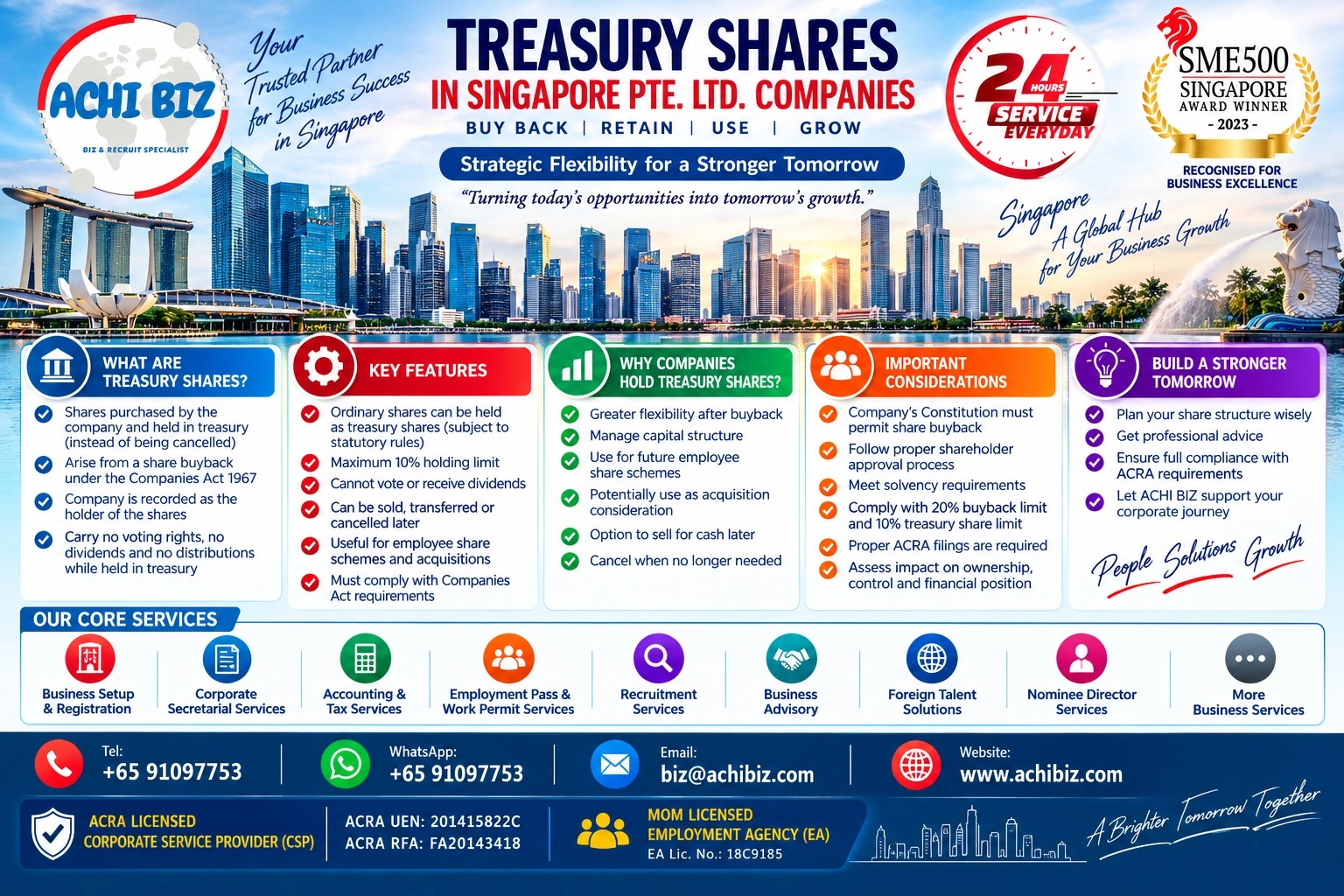
Treasury Shares in Pte Ltd Companies – FAQ Guide
Treasury Shares can give a Singapore private limited company useful flexibility after it buys back some of its own shares. Instead of cancelling qualifying repurchased shares immediately, the company may, where the statutory requirements are satisfied, retain them as Treasury Shares and subsequently sell, transfer, use or cancel them.
However, Treasury Shares are often misunderstood. They are not simply another block of shares that a company can freely create and keep for future use. Under the Companies Act 1967, Treasury Shares arise from shares purchased or otherwise acquired by the company under the statutory share-buyback framework and held continuously by the company. The Act also places restrictions on the type of shares that can be held in treasury, the maximum number that can be retained, the rights that can be exercised while they are held in treasury, and how they may subsequently be dealt with.
This FAQ article focuses exclusively on Treasury Shares in Singapore Pte. Ltd. companies. Refer to comparison of all types of shares in Pte. Ltd. companies in a detailed article separately.
For the characteristics of Ordinary Shares, Preference Shares and Convertible Preference Shares, please refer to our separate ACHI BIZ FAQ articles on those subjects. Their differences will be addressed separately in our dedicated comparison article rather than repeated here.
Frequently Asked Questions About Treasury Shares in Singapore Pte. Ltd. Companies
What are Treasury Shares in a Singapore Pte. Ltd. company?
Treasury Shares are shares that the company itself has purchased or otherwise acquired under the applicable statutory share-buyback provisions and continues to hold rather than cancelling them.
The Companies Act defines a “treasury share” by reference to a share purchased in circumstances where section 76H applies and which has been held continuously by the company since that purchase.
ACRA explains the concept more practically: after a company buys back its own shares, it can either cancel the shares or keep qualifying shares as Treasury Shares.
Can a Singapore private limited company hold Treasury Shares?
Yes.
Section 76H of the Companies Act permits qualifying ordinary shares or stocks purchased or otherwise acquired by the company under sections 76B to 76G to be held in treasury.
This is available to Singapore private companies, subject to the applicable Companies Act requirements.
Can a company simply issue new shares directly to itself as Treasury Shares?
No. Treasury Shares should not be understood as newly created shares that a company simply allots to itself for future use.
They arise through the statutory mechanism under which qualifying shares are purchased or otherwise acquired by the company and retained in treasury.
This distinction is fundamental when planning a company’s share structure.
Must Treasury Shares originate from a share buyback?
In the normal context addressed by sections 76B to 76H, Treasury Shares result from ordinary shares or stocks purchased or otherwise acquired by the company in accordance with the statutory acquisition framework and then retained rather than cancelled.
Accordingly, the company first needs a valid underlying acquisition of its own shares.
Is the company itself regarded as the holder of its Treasury Shares?
Yes.
Section 76H provides that where ordinary shares or stocks are held in treasury, the company is entered in the relevant register as the member holding those shares or stocks.
This is unusual because the company is effectively holding shares in itself, which is why special statutory restrictions apply to those shares.
Can Preference Shares be held as Treasury Shares?
This is an important distinction.
Under section 76B(5A), preference shares purchased or acquired by the company under the statutory buyback provisions are deemed to be cancelled immediately upon purchase or acquisition. By contrast, qualifying ordinary shares may be retained in treasury under section 76H instead of being immediately cancelled.
Therefore, a company should not assume that every class of shares it buys back can be held as Treasury Shares.
For the general features of Preference Shares, refer to our separate article on Preference Shares in Singapore Pte. Ltd. companies.
Can Convertible Preference Shares purchased by the company automatically become Treasury Shares?
A company should not make that assumption.
The statutory Treasury Share framework under section 76H refers to qualifying ordinary shares or stocks, while section 76B provides that preference shares purchased or acquired under the relevant provisions are deemed cancelled immediately.
For the characteristics and conversion mechanism of Convertible Preference Shares, refer to our separate ACHI BIZ article.
Why would a Singapore Pte. Ltd. company want to hold Treasury Shares?
The principal attraction is future flexibility.
Instead of permanently cancelling all qualifying shares after a buyback, the company can retain some of them and later deal with them in ways permitted by section 76K.
Depending on the company’s plans, Treasury Shares may potentially be useful for:
- future share schemes;
- transferring shares to employees or directors under a share scheme;
- raising cash by subsequently selling the Treasury Shares;
- using shares as consideration in an acquisition;
- managing the company’s capital structure; or
- cancelling the shares later if they are no longer required.
The appropriate reason will depend on the company’s circumstances.
Why might a company buy back shares in the first place?
ACRA states that companies commonly undertake share buybacks when they have excess capital that is not required for business operations.
ACRA also identifies possible benefits such as improving financial ratios, reducing share supply and reducing the overall cost of capital.
For a private company, other commercial reasons may arise depending on its ownership structure, although each proposed buyback should be evaluated on its own facts.
Is a share buyback automatically a Treasury Share transaction?
No.
After a qualifying share buyback, the company may either cancel the qualifying shares or hold them as Treasury Shares.
The company therefore needs to decide how the acquired shares are to be treated and make the corresponding corporate and ACRA filings correctly.
What happens if bought-back ordinary shares are not held as Treasury Shares?
Section 76B provides that ordinary shares purchased or acquired under the relevant statutory provisions are deemed cancelled immediately unless they are held in treasury in accordance with section 76H.
This is why the company’s intended treatment of the repurchased shares should be clear before completing the transaction.
Must the company’s Constitution permit it to buy back its own shares?
Yes.
Section 76B(1) provides that a company may purchase or otherwise acquire shares issued by it under the statutory framework if it is expressly permitted to do so by its Constitution.
The Constitution should therefore be reviewed before initiating a share buyback.
What if the Constitution does not permit a share buyback?
The company should not simply proceed with the buyback.
Because section 76B expressly requires constitutional authority, the company’s Constitution and the requirements for any proposed amendment should first be considered.
Where an amendment is required, the appropriate corporate approval and filing procedures should be completed before proceeding with the proposed buyback.
Does a company need shareholder approval for a share buyback?
The required approval depends on the type of buyback.
For unlisted companies, ACRA currently identifies the principal routes as:
- off-market purchase – members’ approval at a general meeting is required;
- selective off-market purchase – a special resolution is required, and the selling shareholders cannot vote; and
- contingent purchase contract – a special resolution is required.
Market purchases apply to listed companies.
A Singapore Pte. Ltd. company therefore needs to identify the correct buyback route rather than applying one approval process to every transaction.
What is an off-market share buyback?
For a private company, a share purchase will generally occur outside a stock exchange.
The Companies Act provides specific procedures for off-market acquisitions, including an equal access scheme under section 76C and a selective off-market acquisition under section 76D.
The correct procedure depends on how the buyback is structured and which shareholders are being offered the opportunity to sell.
What is an equal-access off-market share buyback?
Broadly, an equal-access arrangement is structured so that the opportunity to participate is offered according to the statutory framework rather than selectively to only one chosen shareholder.
Because the procedural requirements are important, the company should review section 76C and its proposed offer carefully before implementing the transaction.
What is a selective off-market share buyback?
A selective off-market acquisition is a buyback directed at particular shareholder(s), rather than being conducted as an equal-access arrangement.
ACRA states that a special resolution is required and that the shareholders whose shares are being purchased cannot vote on that resolution.
This can be particularly relevant to private companies where a specific shareholder is exiting.
Can a company use a share buyback to facilitate a shareholder’s exit?
Potentially, yes, if the statutory requirements and the company’s Constitution permit the transaction.
However, the company should not treat a buyback as merely a private payment arrangement between the company and the departing shareholder.
The transaction involves the company’s own funds, affects its capital structure and must satisfy the Companies Act requirements, including the applicable approval and solvency rules.
Is there a limit on how many ordinary shares a company can buy back?
Yes.
Under section 76B, the total number of ordinary shares or stocks in a class that may generally be purchased or acquired during the relevant period must not exceed 20% of the total number of ordinary shares or stocks in that class, calculated according to the statutory rules.
The “relevant period” generally runs from the applicable buyback resolution until the next AGM is held or required by law to be held, whichever is earlier.
The calculation should be checked for the actual transaction, particularly where there have been capital changes.
Is the share-buyback limit the same as the Treasury Share holding limit?
No. These are two separate limits and should not be confused.
The Companies Act generally permits up to 20% of qualifying ordinary shares in a class to be purchased or acquired during the relevant period under section 76B, subject to its detailed rules.
However, section 76I separately limits the number of shares that may actually be held as Treasury Shares to 10% at any time.
This distinction is important in practical share-capital planning.
What is the maximum number of Treasury Shares a company may hold?
Under section 76I:
- where the company has only one class of shares, Treasury Shares must not exceed 10% of the total number of shares of the company at that time; and
- where the company has different classes, the Treasury Shares of any class must not exceed 10% of the total number of shares in that class at that time.
Companies should therefore monitor the Treasury Share balance after every relevant share transaction.
What happens if the 10% Treasury Share limit is exceeded?
Section 76I requires the company to dispose of or cancel the excess Treasury Shares within six months from the date the limit was exceeded, or within such further period as the Registrar may allow.
The 10% threshold should therefore be treated as an ongoing compliance limit, not merely something checked when the shares are first bought back.
Can changes in the company’s share capital cause the Treasury Share percentage to exceed 10% later?
Potentially, yes.
Because the statutory limit applies at any time, subsequent changes to the company’s share structure may affect the percentage represented by Treasury Shares.
Companies holding Treasury Shares should therefore reassess the statutory percentage whenever their issued share structure changes.
Can a company hold Treasury Shares indefinitely?
The Companies Act does not impose a general expiry period simply because qualifying shares are being held in treasury, subject to continued compliance with the statutory requirements and the 10% maximum holding limit.
Section 76K allows a private company to deal with Treasury Shares at any time in the permitted ways.
Accordingly, the decision on when to dispose of or cancel them can form part of the company’s capital planning.
Can Treasury Shares vote at shareholder meetings?
No.
Section 76J provides that the company must not exercise any rights in respect of Treasury Shares. It specifically includes the right to attend or vote at meetings, and Treasury Shares are treated as having no voting rights while held in treasury.
This is a fundamental feature of Treasury Shares.
Are Treasury Shares counted as votes held by the company itself?
No.
The company cannot use Treasury Shares to vote in its own shareholder decisions. Any purported exercise of such rights is void under section 76J.
Treasury Shares therefore cannot be used by directors as an internal voting block to influence shareholder resolutions.
Can Treasury Shares be used to help directors retain voting control?
The company cannot vote Treasury Shares.
Accordingly, directors cannot use Treasury Shares themselves as votes at a shareholder meeting.
However, buybacks and subsequent disposal of Treasury Shares can affect the wider ownership structure. Directors should therefore consider their duties and the proper purpose of the transaction rather than viewing Treasury Shares simply as a mechanism for influencing control.
Do Treasury Shares receive dividends?
No.
Section 76J provides that no dividend may be paid to the company in respect of Treasury Shares.
A company therefore does not pay a dividend to itself on shares it holds in treasury.
Can Treasury Shares participate in distributions of company assets?
Generally, no.
Section 76J prohibits distributions of the company’s assets to the company in respect of its Treasury Shares, including distributions on winding up.
This reflects the principle that Treasury Shares do not carry normal shareholder economic rights while held by the issuing company.
Can Treasury Shares receive bonus shares?
There is a specific statutory exception.
Section 76J does not prevent the allotment of fully paid bonus shares in respect of Treasury Shares. Shares allotted in this way are treated for Companies Act purposes as if they were purchased by the company in circumstances where section 76H applied.
The resulting Treasury Share limits should still be monitored.
Can Treasury Shares be subdivided or consolidated?
Yes, subject to the statutory condition.
Section 76J permits subdivision or consolidation of Treasury Shares provided the total value after the subdivision or consolidation remains the same as the total value beforehand.
The company’s share records and ACRA information should be updated appropriately for the underlying transaction.
Can Treasury Shares be sold later?
Yes.
Section 76K permits a private company to sell Treasury Shares for cash.
This is one of the key practical advantages of retaining shares in treasury rather than cancelling them immediately.
What does “cash” mean when Treasury Shares are sold?
Section 76K gives “cash” a specific statutory meaning for this purpose. It can include cash or foreign currency received by the company, a qualifying cheque, release of a liquidated liability owed by the company, or an undertaking to pay cash within the statutory period.
Companies contemplating an unusual disposal arrangement should review the precise statutory requirements before proceeding.
Can Treasury Shares be transferred to employees?
Yes.
Under the current section 76K framework for a private company, Treasury Shares may be transferred for the purposes of or pursuant to a share scheme, including schemes for employees, directors or other persons.
This can make Treasury Shares useful where a company expects to operate an employee or management equity incentive arrangement.
Can Treasury Shares be transferred to directors under a share scheme?
Yes, the current private-company provision expressly contemplates share schemes for employees, directors or other persons.
However, any proposed director-related transaction should also be reviewed for applicable governance, disclosure, approval and directors’ duties considerations.
Can Treasury Shares be used for an acquisition?
Yes.
Section 76K permits a private company to transfer Treasury Shares as consideration for acquiring shares in or assets of another company, or assets of another person.
This can give the company strategic flexibility because existing Treasury Shares may potentially be used as transaction consideration instead of paying the entire acquisition price in cash.
Can Treasury Shares be cancelled later?
Yes.
A company holding Treasury Shares may cancel all or some of them.
ACRA expressly states that Treasury Shares may be cancelled either fully or partially.
Once cancelled, they cease to exist and cannot subsequently be reused.
Can only some Treasury Shares be cancelled while the rest are retained?
Yes.
ACRA confirms that a company may undertake either a full cancellation or partial cancellation of its Treasury Shares.
This allows the company to retain part of its Treasury Share pool for future use while permanently cancelling the balance.
Can Treasury Shares be transferred or used for any purpose the directors choose?
No.
Section 76K specifies the ways in which Treasury Shares may be dealt with, including sale for cash, transfer under qualifying share schemes, use as acquisition consideration, cancellation and other purposes prescribed by the Minister.
Directors should therefore identify a valid statutory basis before disposing of Treasury Shares.
What happens to Treasury Shares after they are sold to a new shareholder?
Once the company disposes of the Treasury Shares and the transaction becomes effective, they are no longer continuously held by the company as Treasury Shares.
The recipient then holds the shares subject to the rights attaching to the relevant class and the company’s applicable corporate arrangements.
The company’s shareholder and ACRA records should accurately reflect the transaction.
Does selling Treasury Shares create new shares?
Not in the sense of a fresh allotment of newly created shares.
Treasury Shares already exist and are being held by the company. A subsequent disposal transfers those existing shares out of treasury.
This is commercially important because a Treasury Share disposal should not automatically be treated as though the company were carrying out a fresh allotment.
Can disposal of Treasury Shares affect existing shareholders’ ownership percentages?
Yes.
Although the shares already exist, while they are held in treasury they do not exercise voting rights. When they are transferred out of treasury to another holder, the practical voting and economic position of the company’s shareholders may change.
Companies should therefore prepare a pre-disposal and post-disposal cap table before a material Treasury Share transaction.
Can Treasury Shares affect voting percentages even though they cannot vote?
Yes, indirectly.
While the Treasury Shares themselves carry no voting rights in the company’s hands, a buyback can change the relative voting position of the remaining voting shareholders.
If Treasury Shares are later disposed of to another person, those shares may again carry the rights attached to their class in the hands of the new holder.
The company should therefore consider both the immediate and future governance effect.
Can Treasury Shares affect earnings per share or other financial ratios?
Potentially.
ACRA identifies improvement of financial ratios such as earnings per share (EPS) and return on equity (ROE) among possible benefits associated with share buybacks.
However, the accounting effect depends on the company’s circumstances and applicable financial reporting standards. Companies should obtain accounting advice rather than assuming a particular result.
Are Treasury Shares shown as an investment asset of the company?
The accounting treatment of Treasury Shares should be determined under the applicable accounting standards.
Companies should not assume that buying their own shares creates an ordinary investment asset simply because they have paid money to acquire them.
The legal Companies Act treatment and financial-statement presentation are related but separate questions, so accounting advice should be obtained where necessary.
Can a company use profits to fund a share buyback?
Yes, subject to the Companies Act.
Section 76F permits the relevant payment to be made out of the company’s capital or profits, provided the company is solvent.
ACRA also notes that companies commonly use capital and profits to fund share buybacks.
Can a company use capital to buy back its own shares?
Yes, provided the statutory conditions are met, including the solvency requirement under section 76F.
The fact that the company has sufficient cash in its bank account is not, by itself, enough to establish that the statutory solvency test has been satisfied.
What is the solvency requirement for a share buyback?
Section 76F permits the relevant payments only where the company is solvent.
The current statutory test addresses whether:
- there is any ground on which the company could be found unable to pay its debts;
- it can meet the applicable 12-month debt-payment requirement; and
- the value of its assets is not less than its liabilities, including contingent liabilities, and will not become so as a result of the proposed transaction.
This should be assessed seriously before company funds are committed.
Why is solvency particularly important when buying back shares?
Because a share buyback uses company resources to pay shareholders who are selling their shares.
Those resources may otherwise be available for operating expenses, creditors, investment or future distributions.
The statutory solvency test therefore protects against a company returning funds to shareholders through a buyback when its financial position does not support the transaction.
What happens if directors knowingly approve a buyback when the company is not solvent?
This can have serious consequences.
Under section 76F, a director or chief executive officer who approves or authorises the relevant transaction knowing that the company is not solvent may be liable on conviction to a fine of up to S$100,000 or imprisonment for up to three years, without affecting other potential liability.
Solvency should therefore never be treated as a box-ticking exercise.
Does having enough cash in the bank prove that the company is solvent?
No.
Liquidity is relevant, but the statutory test goes further.
It considers the company’s ability to pay debts and its assets relative to liabilities, including contingent liabilities.
Directors should consider the company’s overall financial position, not merely the bank balance on the transaction date.
Can a buyback reduce the funds available for future dividends?
Yes.
ACRA specifically notes that where profits are used to fund share buybacks, less money will be available for future dividend payments.
This is an important commercial consideration for shareholders who remain in the company.
Is a Treasury Share transaction the same as a capital reduction?
No.
ACRA expressly distinguishes a share buyback from a reduction of share capital and explains that they have different purposes and mechanics.
Companies should therefore identify the transaction they actually intend to undertake before preparing resolutions or making ACRA filings.
Does a shareholder have to sell shares back to the company during a buyback?
Not simply because the company wishes to conduct a buyback.
ACRA distinguishes share buybacks from capital reductions partly on the basis that, in a buyback, shareholders can choose whether to sell their shares back to the company, subject to the particular buyback arrangement.
A selective transaction nevertheless needs to comply with its specific statutory process.
Can a company buy back shares from only one shareholder?
Potentially, through an appropriately structured selective off-market acquisition.
ACRA states that such a transaction requires a special resolution and that the shareholder whose shares are being purchased cannot vote on the resolution.
The Constitution and transaction documents should also be reviewed.
Can Treasury Shares be useful for employee share schemes?
Yes.
This is one of the express statutory uses permitted by section 76K.
Instead of issuing new shares when shares are needed under a qualifying scheme, a private company may potentially transfer Treasury Shares it already holds, subject to the scheme and applicable approvals.
This can provide useful capital-management flexibility.
Can Treasury Shares help a company avoid issuing new shares in the future?
Potentially, for transactions where section 76K permits the Treasury Shares to be used.
For example, Treasury Shares can potentially be sold for cash, transferred under a share scheme or used as acquisition consideration.
Whether using Treasury Shares is preferable to issuing new shares depends on the company’s circumstances and should be analysed separately.
Are Treasury Shares useful only for large companies?
No.
The statutory Treasury Share framework is available to private companies as well.
However, smaller owner-managed companies should consider whether the administrative and financial complexity is justified. In a company with only a few shareholders, the effect of a buyback on control and ownership percentages can be particularly significant.
Can a small family-owned Pte. Ltd. company hold Treasury Shares?
Potentially, yes, if the statutory requirements are satisfied.
A family company might encounter Treasury Shares following a properly structured buyback—for example, as part of a shareholder exit or capital restructuring.
However, the transaction should not be undertaken merely to create Treasury Shares. The commercial purpose, solvency, shareholder approvals, ownership consequences and future plans for those shares should all be considered.
Can Treasury Shares be used in succession planning?
Potentially, as part of a wider corporate restructuring or ownership plan.
For example, a company may undertake a lawful buyback in connection with a shareholder exit and retain qualifying shares in treasury for an appropriate future use.
However, succession planning can involve tax, estate, valuation, governance and family arrangements beyond corporate-secretarial compliance. Professional advice may therefore be necessary.
Can Treasury Shares be used to remove a difficult shareholder?
A company should be cautious with this reasoning.
A share buyback must follow the applicable statutory process, and a selective buyback cannot simply be used as an informal mechanism to force a shareholder out.
Directors must also continue to comply with their duties and act for proper corporate purposes.
Where a shareholder dispute exists, legal advice should generally be obtained before attempting a buyback.
Can Treasury Shares be used to manipulate control of a company?
Treasury Shares themselves cannot vote, and the company cannot exercise shareholder rights attached to them while they remain in treasury.
Nevertheless, buying shares back from particular shareholders or subsequently disposing of Treasury Shares can affect relative voting positions.
Directors should therefore carefully consider their statutory and fiduciary duties, proper purpose and the interests of the company when approving such transactions.
Should directors consider the purchase price carefully?
Yes.
The company is using corporate resources to acquire its own shares. The directors should therefore consider whether the price and transaction are commercially justifiable and consistent with their duties.
In a private company without a public market price, valuation can be particularly important because determining a fair or commercially supportable price may be less straightforward.
Is an independent valuation compulsory for every private-company share buyback?
Not necessarily as a universal requirement under the Treasury Share provisions themselves.
However, valuation may be advisable where the transaction is material, involves related parties, is selective, may affect control, or where shareholders disagree about value.
The company should distinguish between what is legally mandatory and what is prudent corporate governance for the circumstances.
Can Treasury Shares have tax consequences?
Yes, depending on the transaction and the parties involved.
A share buyback, payment to the selling shareholder, subsequent sale or transfer of Treasury Shares and employee share arrangements can raise tax questions.
Corporate-secretarial treatment under the Companies Act does not determine every tax consequence. Appropriate Singapore tax advice should therefore be obtained where material.
Can stamp duty apply when Treasury Shares are subsequently transferred?
Share transactions can have stamp-duty implications depending on the nature and documentation of the transaction.
The company should assess the specific transfer rather than assume that a Treasury Share disposal is automatically exempt merely because the shares were previously held by the company.
Where relevant, Singapore tax and stamp-duty advice should be obtained before execution.
Does a company need to notify ACRA when it buys back shares?
Yes, the applicable filing must be made.
For a private company, ACRA states that the notice of purchase or acquisition should be filed so that the transaction appears in the company’s Electronic Register of Members (EROM).
The filing records information including the shares purchased, shares cancelled and shares held in treasury.
When does a private company’s share buyback take effect?
ACRA’s current guidance states that for a private company the purchase/acquisition takes effect on the same date as the filing once the company’s EROM has been updated.
This makes accurate and timely Bizfile filing an important part of completing the transaction.
Is there an ACRA filing fee for the notice of purchase or acquisition?
ACRA currently states that the filing is free and has immediate approval processing.
Companies should nevertheless check the prevailing requirements when the actual transaction occurs.
Who can file the share-buyback notice with ACRA?
ACRA states that company officers, such as a director or company secretary, may file directly.
Alternatively, the company may engage a Corporate Service Provider (CSP) to file on its behalf.
Does ACRA need to be notified when Treasury Shares are cancelled?
Yes.
ACRA provides a specific notice of cancellation or disposal of Treasury Shares.
The correct transaction should be selected in Bizfile so that the company’s share information and EROM remain accurate.
Does ACRA need to be notified when Treasury Shares are sold or transferred?
Yes, the applicable disposal filing should be made.
For a private company, ACRA states that the cancellation or disposal should be filed so that it appears in the company’s EROM, and the cancellation/disposal takes effect on the filing date once the EROM has been updated.
Is there an ACRA fee for filing a Treasury Share cancellation or disposal?
ACRA currently lists the filing as free, with immediate approval.
The current Bizfile service is File notice of cancellation or disposal of treasury shares under S76K.
Why is the Electronic Register of Members important for Treasury Shares?
For private companies, ACRA’s EROM forms an important part of the legal and administrative completion of share transactions.
The company’s purchase/acquisition and later cancellation or disposal of Treasury Shares should therefore be reflected correctly in the EROM.
Internal records should also remain consistent with ACRA’s information.
What records should a company maintain for Treasury Shares?
Depending on the transaction, records should generally include:
- the company’s Constitution;
- applicable shareholder resolutions;
- board resolutions;
- buyback offer or agreement;
- relevant notices and approvals;
- solvency supporting information;
- purchase-price calculations;
- evidence of payment;
- ACRA notice of purchase/acquisition;
- records identifying shares held in treasury;
- updated cap table;
- documents relating to any later sale, transfer or cancellation;
- ACRA cancellation/disposal filing; and
- appropriate accounting records.
Good documentation is particularly important where the shares may remain in treasury for several years before being used.
Should Treasury Shares be shown separately in the company’s cap table?
Yes.
A clear cap table should distinguish Treasury Shares from shares held by external shareholders.
It can also be useful to show the voting position separately because Treasury Shares themselves carry no voting rights while held by the company.
Should the company review its cap table before buying back shares?
Yes.
A pre-buyback and post-buyback analysis can reveal the effect on:
- shareholder percentages;
- voting influence;
- control;
- remaining share classes;
- Treasury Share percentage;
- future employee or investor allocations; and
- the company’s ability to undertake subsequent capital transactions.
The transaction should be understood numerically before it is approved.
Should the company prepare another cap table before disposing of Treasury Shares?
Yes.
A future Treasury Share disposal can change the ownership and voting structure again.
The company should therefore model the position before and after the proposed disposal, particularly if the shares will be transferred to an investor, director, employee or other significant stakeholder.
Do Treasury Shares count towards the company’s 50-shareholder limit as though the company were another external shareholder?
This should not be approached merely by looking at the company being entered as the holder in the register.
Treasury Shares are subject to a special statutory regime and the company cannot exercise normal membership rights in respect of them.
Where shareholder-number limits or another regulatory calculation is material to a particular transaction, the company should assess the applicable statutory definition rather than simply treating the company like an ordinary external shareholder.
Do Treasury Shares have beneficial ownership implications?
The company is recorded as the holder of its Treasury Shares, but the shares are subject to the specific Treasury Share regime.
Separately, Singapore companies have obligations relating to registrable controllers, nominee arrangements and beneficial ownership transparency. Those requirements should be assessed independently based on the company’s actual ownership and control structure.
Treasury Shares should not be used as a mechanism to obscure beneficial ownership.
What are the main benefits of holding Treasury Shares?
Depending on the company’s circumstances, potential benefits include:
- retaining flexibility after a share buyback;
- ability to sell qualifying shares later for cash;
- ability to use shares for qualifying share schemes;
- ability to use shares as acquisition consideration;
- avoiding immediate cancellation of all qualifying repurchased shares;
- maintaining a pool of existing shares for permitted future corporate purposes;
- facilitating capital-management strategies; and
- allowing later cancellation if the shares are ultimately not required.
These benefits should always be weighed against the financial and administrative implications.
What are the main risks of holding Treasury Shares?
Potential risks include:
- breaching the 10% Treasury Share limit;
- carrying out an invalid underlying buyback;
- failing the statutory solvency requirements;
- using company funds imprudently;
- incorrect shareholder approval procedures;
- governance disputes;
- unexpected changes in shareholder voting percentages;
- inappropriate disposal of Treasury Shares;
- incorrect ACRA filings;
- accounting or tax complications;
- poor record-keeping; and
- confusion between Treasury Shares and other share transactions.
The flexibility of Treasury Shares does not remove the need for careful compliance.
Are Treasury Shares automatically beneficial to the company?
No.
A company should not buy back shares simply because Treasury Shares may be useful later.
The buyback consumes corporate resources. ACRA itself notes that using profits for a buyback leaves less money available for future dividends.
The board should therefore consider whether holding the funds for operations, expansion, debt repayment, working capital or other corporate purposes would better serve the company.
What should directors consider before creating Treasury Shares through a buyback?
A practical review should consider:
- Why is the company proposing the buyback?
- Does the Constitution expressly permit the company to purchase its own shares?
- Which shares are being purchased?
- Can those shares legally be retained as Treasury Shares?
- Which statutory buyback procedure applies?
- What shareholder approval is required?
- Is the purchase price commercially supportable?
- Is the company solvent under section 76F?
- How will the buyback be funded?
- What will the ownership and voting structure look like afterward?
- How many Treasury Shares will the company hold?
- Will the 10% Treasury Share limit be satisfied?
- What does the company intend to do with the Treasury Shares?
- What ACRA filing is required?
- Are there accounting, tax or legal issues requiring specialist advice?
These questions should be answered before company funds are committed.
What should be checked before disposing of Treasury Shares?
Before selling or transferring Treasury Shares, the company should generally consider:
- whether the proposed use is permitted under section 76K;
- the number of Treasury Shares involved;
- the proposed recipient;
- the consideration or applicable share-scheme terms;
- directors’ duties and potential conflicts;
- any required corporate approvals;
- the resulting cap table;
- changes to voting and economic interests;
- tax and accounting consequences;
- the relevant transaction documents; and
- the required ACRA filing.
The company should also ensure that its internal share records and EROM remain consistent after completion.
What should be checked before cancelling Treasury Shares?
The company should verify:
- the number and class of Treasury Shares being cancelled;
- whether cancellation is full or partial;
- the necessary corporate approvals and documentation;
- the resulting share-capital records;
- the post-cancellation cap table; and
- the applicable ACRA cancellation filing.
Once Treasury Shares are cancelled, they no longer exist and cannot subsequently be transferred or sold.
Can mistakes in Treasury Share filings be difficult to correct?
Yes.
ACRA warns that share transactions are complex and filing errors can be costly. If an error cannot be resolved through a Notice of Error, an Order of Court may be required to amend it.
This makes careful review before filing particularly important.
Should a company engage a Corporate Service Provider for Treasury Share transactions?
Professional assistance can be useful because Treasury Shares normally involve more than a single Bizfile entry.
The company may need to coordinate:
- Constitution review;
- correct classification of the buyback;
- shareholder and board approvals;
- share-buyback documentation;
- shareholding calculations;
- Treasury Share limits;
- ACRA filings;
- EROM updates; and
- subsequent disposal or cancellation records.
ACRA expressly states that a company may engage a Corporate Service Provider (CSP) to handle the relevant share-buyback and Treasury Share filings.
Where the transaction involves shareholder disputes, complex valuation, unusual rights, tax or accounting issues, the appropriate specialist advisers should also be engaged.
Are Treasury Shares suitable for every Singapore Pte. Ltd. company?
No.
Treasury Shares are useful where the company has a genuine reason to retain qualifying repurchased shares for an anticipated future corporate purpose.
For some private companies, immediate cancellation after a buyback may better reflect the intended transaction. For others, retaining qualifying shares in treasury may provide valuable flexibility.
The better question is therefore not simply:
“Can our company hold Treasury Shares?”
It is:
“Why are we buying back these shares, what do we intend to do with them afterward, and is retaining them in treasury commercially useful and legally compliant?”
That analysis should be undertaken before the buyback is implemented.
Key Takeaway on Treasury Shares in Singapore
Treasury Shares are best understood as a second stage of a qualifying share-buyback transaction, rather than shares that a company simply creates for itself.
For Singapore Pte. Ltd. companies, the key points include:
- the company’s Constitution must expressly permit the purchase or acquisition of its own shares;
- qualifying ordinary shares bought back may be retained as Treasury Shares instead of being cancelled;
- preference shares purchased under the relevant buyback provisions are deemed cancelled and are not retained under the section 76H Treasury Share framework;
- the statutory buyback limit for ordinary shares is generally 20% during the relevant period, subject to the detailed rules in section 76B;
- Treasury Shares actually held by the company are subject to a separate 10% maximum holding limit;
- excess Treasury Shares must generally be disposed of or cancelled within six months, unless the Registrar allows further time;
- Treasury Shares carry no voting rights while held by the company;
- the company cannot receive dividends or ordinary asset distributions on its Treasury Shares;
- a private company may sell Treasury Shares for cash, transfer them under qualifying share schemes, use them as permitted acquisition consideration, or cancel them;
- the underlying share buyback is subject to the applicable shareholder-approval and solvency requirements; and
- purchases, disposals and cancellations must be properly reflected through the applicable ACRA filings and the company’s Electronic Register of Members.
The commercial analysis is equally important. A buyback changes the company’s cash position and may alter the relative ownership and voting influence of remaining shareholders. A later disposal of Treasury Shares can change that position again.
Companies should therefore consider the buyback, Treasury Share holding period and eventual use or cancellation as one connected capital-management strategy.
For detailed analysis of Ordinary Shares, Preference Shares and Convertible Preference Shares in Singapore Pte. Ltd. companies, please refer to our separate ACHI BIZ FAQ articles. Their respective features should not be inferred from this Treasury Shares guide. A separate ACHI BIZ article can address the detailed comparison among Ordinary Shares, Preference Shares, Convertible Preference Shares and Treasury Shares.
How ACHI BIZ Can Assist
ACHI BIZ can assist Singapore private limited companies with the corporate-secretarial and ACRA compliance aspects of Treasury Share and share-capital transactions, including reviewing existing corporate records, coordinating the necessary resolutions and supporting documents, maintaining shareholding records and attending to applicable Bizfile filings.
Where a transaction involves specialised legal drafting, shareholder disputes, valuation, tax or complex accounting issues, the appropriate professional advice should also be obtained.
Related Pages
Why Do Singapore Pte Ltd Companies Commonly Issue Ordinary Shares? – FAQ Guide
Ordinary Shares vs Preference Shares in Pte Ltd Companies – FAQ Guide
#achibiz