
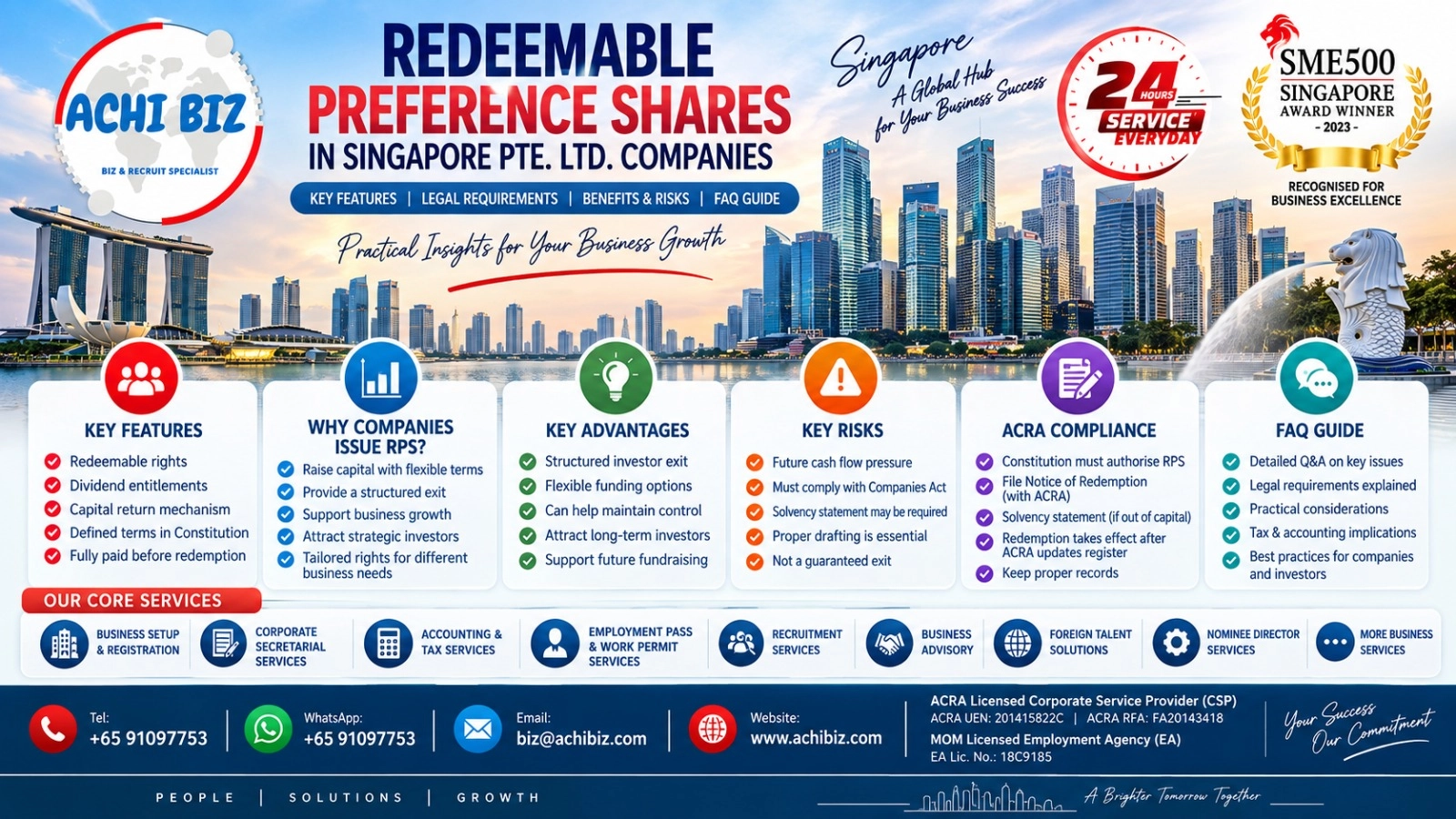
Redeemable Preference Shares in Pte Ltd Companies – FAQ Guide
Redeemable Preference Shares (“RPS”) can be a useful part of the share-capital structure of a Singapore private limited company, particularly where investors and founders want equity funding to be accompanied by a defined mechanism under which the company may later redeem the shares.
Under the Companies Act 1967, a company having share capital may issue redeemable preference shares if its Constitution authorises them, and the redemption must take place on the terms and in the manner provided by the Constitution. The shares cannot be redeemed unless they are fully paid.
For Singapore Pte. Ltd. companies, however, the word “redeemable” should not be mistaken for a simple promise that an investor will automatically receive money back whenever requested. The Constitution, terms of issue, redemption mechanism, source of redemption funds, solvency requirements and ACRA filing requirements all need to work together.
This FAQ guide focuses specifically on Redeemable Preference Shares in Singapore Pte. Ltd. companies. Refer to comparison of all types of shares in Pte. Ltd. companies in a detailed article separately.
For the broader characteristics of Ordinary Shares and Preference Shares, please refer to our separate ACHI BIZ articles on those subjects. Convertible Preference Shares and Treasury Shares are also separate subjects and should be considered through their respective guides. A separate comparison article can be referred to for a structured comparison among the different share types rather than duplicating those issues here. ACRA itself recognises ordinary, preference, redeemable preference, convertible preference and treasury shares as distinct share types.
Frequently Asked Questions About Redeemable Preference Shares in Singapore
What are Redeemable Preference Shares in a Singapore Pte. Ltd. company?
Redeemable Preference Shares are preference shares issued with terms under which the company can subsequently redeem the shares.
ACRA describes them as shares that a company can buy back or redeem later, with the company’s Constitution specifying the applicable redemption terms, including when and how redemption can occur.
Their commercial attraction is therefore not simply that they are preference shares. It is that an exit mechanism can be built into the share terms from the outset.
For example, a company may structure an investment so that the RPS become redeemable after an agreed period or upon circumstances contemplated by the Constitution and terms of issue.
Are Redeemable Preference Shares legally permitted for Singapore private limited companies?
Yes.
Section 70 of the Companies Act 1967 expressly permits a company having share capital, where authorised by its Constitution, to issue preference shares that are redeemable or redeemable at the company’s option.
Accordingly, a Singapore Pte. Ltd. company can have Redeemable Preference Shares, but the company’s constitutional framework must properly support them.
Must the company’s Constitution authorise Redeemable Preference Shares?
Yes. This is fundamental.
Section 70(1) makes the ability to issue RPS subject to authorisation in the company’s Constitution. It also requires the redemption to be carried out on the terms and in the manner provided by the Constitution.
Therefore, before issuing RPS, the company should review its existing Constitution rather than assuming that a general power to issue shares is sufficient for the proposed RPS structure.
What should be considered when drafting RPS provisions in the Constitution?
The drafting should reflect the intended commercial arrangement clearly.
Depending on the structure, matters requiring consideration can include:
- who may initiate redemption;
- when redemption may take place;
- whether there is a fixed redemption date or defined redemption period;
- redemption price or the method for determining it;
- notice requirements;
- whether redemption is subject to specified conditions;
- dividend rights;
- rights attached to the RPS before redemption;
- priority rights where applicable;
- treatment of accrued amounts, if contractually provided;
- what happens if the contemplated redemption cannot lawfully be completed at the intended time; and
- procedural requirements for implementing redemption.
The terms should be drafted with the Companies Act and the company’s wider Constitution in mind.
Can the redemption terms simply be contained in a private agreement with the investor?
A shareholders’ agreement or subscription agreement may contain detailed commercial arrangements, but it should not be treated as a substitute for the statutory requirement concerning the Constitution.
Section 70 expressly links both the authority to issue redeemable preference shares and the terms and manner of redemption to the company’s Constitution.
Accordingly, the Constitution, subscription/investment documents and relevant resolutions should be reviewed together for consistency.
Must Redeemable Preference Shares be fully paid before they can be redeemed?
Yes.
Section 70(3) expressly provides that the shares must not be redeemed unless they are fully paid up.
This is an important pre-redemption compliance check.
Can partly paid Redeemable Preference Shares be issued?
A share may generally be fully or partially paid, as ACRA explains in its general guidance on shares. However, the critical RPS rule is that the RPS cannot actually be redeemed until fully paid up.
Companies therefore need to distinguish between the terms applicable at issuance and the statutory conditions that must be satisfied at redemption.
Does “redeemable” mean the company must always redeem the shares?
Not necessarily.
This depends on the actual RPS terms.
Section 70 contemplates preference shares that are redeemable or, at the option of the company, liable to be redeemed. The precise rights and obligations therefore need to be determined from the Constitution and applicable terms.
It is dangerous to infer a mandatory redemption obligation merely because the shares are labelled “Redeemable Preference Shares”.
Can an investor demand redemption whenever it wants?
Only if the valid terms governing the RPS give the investor an applicable right and the redemption can lawfully be implemented.
The word “redeemable” by itself should not be interpreted as giving a shareholder an unrestricted right to demand immediate repayment.
The Constitution and terms should clearly establish who controls the redemption trigger and under what circumstances.
Can the company decide when to redeem its RPS?
It can be structured that way.
Section 70 specifically recognises preference shares that are redeemable at the option of the company, subject to the terms and manner contained in the Constitution.
This can provide flexibility, but the drafting should be sufficiently clear to avoid disputes over whether redemption is mandatory, optional or conditional.
Can Redeemable Preference Shares have a fixed redemption date?
The commercial terms can provide for redemption according to an agreed timetable or specified event, provided the structure complies with the Companies Act and Constitution.
ACRA gives, as an example, a company issuing RPS with an agreement to buy them back after five years at a fixed price.
However, specifying a future redemption date does not remove the need to satisfy the applicable legal requirements when redemption is actually carried out.
Can RPS be redeemed at a predetermined price?
The redemption terms may establish an agreed redemption price or pricing mechanism.
ACRA describes redeemable preference shares as shares a company can buy back later at an agreed price.
The pricing provision should nevertheless be drafted carefully, particularly where the commercial arrangement involves premiums, accrued entitlements or formula-based calculations.
Can RPS be redeemed at a premium?
A commercial structure may contemplate a redemption amount different from the original issue amount, but the exact terms and their legal, accounting and tax consequences should be reviewed before issuance.
Rather than merely writing “redeemable at a premium”, the documentation should make clear how the redemption amount is determined and what components it represents.
Where can a company obtain the money to redeem its Redeemable Preference Shares?
Section 70 distinguishes importantly between:
redemption out of the company’s capital, and
redemption out of the proceeds of a fresh issue of shares made for the purpose of the redemption.
Where redemption is out of capital, additional statutory solvency requirements apply. Section 70(5) clarifies that redemption using proceeds from a fresh issue made for the purpose of redemption is not treated as redemption out of capital.
ACRA similarly explains that a company may use existing company funds or funds raised from issuing new shares, subject to the applicable requirements.
Can a Singapore Pte. Ltd. redeem RPS out of its capital?
Yes, subject to statutory safeguards.
Under section 70(4), RPS must not be redeemed out of the company’s capital unless:
- all directors have made a solvency statement in relation to the redemption; and
- the company has lodged a copy of that solvency statement with the Registrar.
This is therefore considerably more than an internal accounting decision.
Is a directors’ solvency statement required for every RPS redemption?
No. The statutory solvency-statement requirement in section 70(4) specifically applies where the RPS are being redeemed out of the company’s capital.
ACRA confirms that where redemption is funded by proceeds of a new share issue specifically made for the redemption, those capital-redemption solvency-statement requirements do not apply because such redemption is not treated as redemption out of capital.
This distinction should be checked before preparing the redemption documents.
Do all directors need to make the solvency statement when RPS are redeemed out of capital?
Yes.
The Companies Act expressly refers to all the directors making the solvency statement in relation to the redemption.
A company should therefore not treat this as merely a majority board approval.
What does a solvency statement mean in an RPS redemption?
A solvency statement is a formal statutory statement by the directors concerning the company’s solvency in connection with the proposed transaction.
It should not be treated as a routine formality. Directors should have a proper factual basis for making the statement, including an appropriate understanding of the company’s financial position, liabilities and ability to meet its obligations.
The company and directors should obtain professional advice where there is uncertainty over solvency.
What if the company does not have sufficient financial resources to redeem the RPS?
The existence of a contractual or constitutional redemption mechanism does not justify implementing a redemption contrary to the Companies Act.
This is one of the major practical risks of poorly designed RPS terms.
An investor may expect an exit at a particular time while the company’s financial position may make the contemplated transaction difficult or legally unavailable in the intended form.
For that reason, the redemption provisions should be considered carefully when the shares are first structured, not only when redemption becomes due.
Does issuing RPS guarantee an investor’s exit?
No.
RPS can provide a structured exit mechanism, but they should not be marketed or understood as guaranteeing that cash will always be available on a particular date.
The actual outcome can depend on:
- the RPS terms;
- the company’s Constitution;
- whether the shares are fully paid;
- the company’s financial position;
- the intended source of redemption funds;
- applicable solvency requirements; and
- satisfaction of the necessary corporate and ACRA procedures.
This distinction is particularly important when explaining RPS to investors.
Are RPS equivalent to a loan that the company has to repay?
No. RPS are shares and form part of the company’s share-capital structure.
The fact that they contain a future redemption mechanism should not cause them to be described casually as a loan.
However, their precise accounting treatment may require professional assessment under the applicable accounting standards because the contractual terms can matter significantly. Legal share classification and accounting presentation should not simply be assumed to be identical.
Does an RPS investor become a shareholder?
Yes. Until redemption takes effect, the holder holds shares in the company and has the rights attached to that class.
The exact rights should therefore be determined from the Constitution and terms governing the RPS.
What rights can be attached to Redeemable Preference Shares?
This depends on how the class is structured.
Potential matters include:
- dividend entitlements;
- voting rights;
- capital-return rights;
- redemption rights;
- priority arrangements;
- participation rights;
- information or consent rights, where appropriately documented; and
- other class-specific provisions permitted by law.
Because RPS are a form of preference share, the statutory requirements governing preference-share rights also need to be considered when establishing the class.
For a detailed discussion of the general characteristics of Preference Shares in Singapore Pte. Ltd. companies, refer to our separate Preference Shares FAQ article rather than treating this RPS guide as a substitute.
Do RPS automatically carry a fixed dividend?
No.
The word “redeemable” describes the redemption characteristic. It does not by itself determine every other economic right attached to the shares.
Dividend entitlements must be determined from the applicable share terms and Constitution.
Do RPS automatically have no voting rights?
No.
Voting rights should not be assumed merely from the RPS label.
The actual rights attached to the class need to be examined. This is another reason why a properly drafted Constitution and share terms are important.
Does redemption mean that the investor sells the shares to another shareholder?
No.
Redemption is a transaction under which the company itself redeems the RPS according to the statutory and constitutional framework.
That is different from a shareholder privately transferring shares to another person.
Is redemption of RPS the same as an ordinary share buyback?
It should not be treated as the same transaction.
Redemption of redeemable preference shares has its own statutory framework under section 70 of the Companies Act and its own ACRA filing process.
The fact that both transactions can result in a company paying money in connection with its own shares does not make the legal procedures interchangeable.
Is redemption of RPS the same as a capital reduction?
No.
A capital reduction is a separate corporate transaction with its own statutory procedures. ACRA separately categorises redemption of redeemable preference shares and reduction of share capital as different share-capital transactions.
The correct procedure should therefore be identified before any Bizfile filing is made.
Are redeemed RPS treated as Treasury Shares?
Do not automatically treat redeemed RPS as Treasury Shares.
Treasury Shares are a separate subject with their own statutory rules and ACRA procedures. ACRA separately identifies Redeemable Preference Shares and Treasury Shares as different share types.
Please refer to our separate article on Treasury Shares in Singapore Pte. Ltd. companies for that topic.
Are Redeemable Preference Shares the same as Convertible Preference Shares?
No. ACRA identifies them separately.
This article deliberately does not compare the two. Please refer to our separate guide on Convertible Preference Shares in Singapore Pte. Ltd. companies for their features, conversion mechanism, benefits and risks.
Can existing shares be converted into redeemable shares?
Share conversion is a separate transaction and should be assessed carefully.
ACRA states that certain ordinary shares may be converted into certain types of preference or redeemable shares where the necessary requirements are satisfied. Importantly, ACRA also states that non-redeemable preference shares cannot be converted into redeemable preference shares.
The company’s Constitution should first be checked to determine whether the contemplated conversion is permitted.
What if the Constitution does not permit the required share conversion?
ACRA states that, where the Constitution does not allow share conversions, the company needs to amend it by passing the necessary special resolution and lodge the resolution before carrying out the conversion filing. ACRA describes a special resolution in this context as requiring at least 75% shareholder approval.
However, companies should consider the specific transaction, existing class rights and Constitution rather than assuming that constitutional amendment alone resolves every issue.
Does issuing RPS require directors’ authority to issue shares?
The general statutory requirements governing the issue/allotment of shares should still be considered.
The fact that shares are redeemable does not mean the company can disregard the normal corporate approvals applicable to issuing shares.
The company secretary or professional adviser should therefore examine both:
- the requirements applicable to the issue of the shares, and
- the special requirements applicable to their future redemption.
Should the RPS terms be decided before the shares are allotted?
Yes. This is strongly preferable.
Important economic rights should not be left ambiguous until the investor later seeks redemption.
Before allotment, the company and investor should understand matters such as:
When can redemption occur?
Who can trigger it?
At what price?
How is the amount calculated?
What rights exist before redemption?
What happens if legal redemption conditions cannot be satisfied?
Resolving these matters upfront can significantly reduce future disputes.
Can different classes of Redeemable Preference Shares be created?
Potentially, yes, where the company’s Constitution and applicable law support the structure.
For example, commercial requirements may lead to different RPS classes with different redemption dates, dividend arrangements or economic rights.
However, introducing multiple classes increases governance complexity. Each class should be clearly identified and its rights properly documented.
Can RPS be issued to a founder?
There is no general principle that RPS are only for outside investors.
Whether they are commercially appropriate for a founder depends on why the class is being created and what rights are intended.
The company should avoid choosing a share type merely because it appears sophisticated. The share structure should serve a genuine commercial purpose.
Can RPS be issued to a corporate investor?
A Singapore private company limited by shares may have individual or corporate shareholders, subject to the rules applicable to private companies. ACRA notes that a private company limited by shares can have up to 50 shareholders, including individuals or corporate entities.
Accordingly, an RPS investor can potentially be a corporate shareholder.
Why might a startup issue Redeemable Preference Shares?
RPS can be considered where investors want equity participation together with an agreed future redemption framework.
Possible commercial objectives include:
- providing an investor with a defined potential exit route;
- accommodating investors with a particular investment horizon;
- creating tailored investment terms;
- facilitating private investment without an immediate permanent ownership expectation; or
- structuring funding around anticipated future liquidity.
However, whether RPS are suitable depends heavily on the company’s future cash-flow expectations and the actual terms.
Why might an established family-owned company use RPS?
A closely held business might consider RPS when bringing in capital while wanting to establish from the beginning how the investor’s shareholding may later be exited.
The advantage is not simply “keeping control”. The real value lies in planning the entry and potential exit mechanics together.
The arrangement should still be commercially realistic and legally compliant.
Can RPS help companies plan investor exits?
Yes, this is one of their most significant structural uses.
Instead of leaving the investor’s eventual exit entirely dependent on finding a third-party purchaser, RPS can establish a company-redemption mechanism.
But the mechanism is only useful if the company can actually satisfy the applicable requirements when redemption is contemplated.
What are the main benefits of Redeemable Preference Shares?
Potential benefits include:
- a predefined redemption framework;
- flexibility in structuring private investment;
- ability to tailor investor rights;
- clearer planning around an investor’s investment horizon;
- potential company-controlled redemption where appropriately structured;
- ability to combine preference rights with a redemption mechanism; and
- an alternative means of structuring equity funding for particular commercial objectives.
These are potential benefits, not automatic outcomes.
What are the principal risks of issuing Redeemable Preference Shares?
Key risks include:
- poorly drafted redemption provisions;
- unrealistic redemption timelines;
- future cash-flow pressure;
- misunderstanding redemption as guaranteed repayment;
- insufficient constitutional authority;
- inconsistent Constitution and investment agreements;
- failure to satisfy the fully-paid requirement;
- failure to satisfy solvency requirements for redemption out of capital;
- incorrect corporate approvals;
- incorrect ACRA filings;
- disputes over redemption price or timing; and
- unexpected accounting or tax consequences.
The more customised the RPS terms, the more important careful drafting becomes.
Can RPS create future cash-flow pressure for the company?
Yes.
This is one of the most important commercial considerations.
A company may receive investment today but face a substantial redemption requirement several years later. Management should therefore model the potential future cash requirement before agreeing to redemption terms.
An attractive funding arrangement at issuance can become problematic if the company commits to an unrealistic exit structure.
What happens if several RPS investors become entitled to redemption around the same time?
This should ideally be considered during structuring.
Multiple redemptions can create concentrated liquidity demands. Companies should consider whether the terms address timing, sequencing and other relevant mechanics, subject always to the Companies Act.
A cap table showing the number of RPS, their issue terms and potential redemption periods can be valuable for planning.
Should directors consider creditors when approving redemption?
Directors should not view redemption purely as a shareholder transaction.
Where redemption is being made out of capital, the statutory requirement for all directors to make a solvency statement reflects the importance of the company’s ability to meet its obligations.
Directors should therefore approach the solvency assessment seriously rather than treating it as an administrative step.
Can directors make a solvency statement merely because the shareholders want redemption?
They should not.
A solvency statement is a statutory statement based on the directors’ assessment of the company’s financial position. Commercial pressure from an investor or shareholder does not replace that assessment.
Where the directors cannot properly form the required opinion, professional legal and financial advice should be obtained before proceeding.
Does the company need to notify ACRA when RPS are redeemed?
Yes.
ACRA states that a company redeeming RPS must file a notice of redemption. For a private company, section 70(6) provides for redemption by lodging the prescribed notice with the Registrar.
The filing is made through ACRA’s share-information eService.
Who can file the notice of redemption with ACRA?
ACRA states that company officers, such as a director or company secretary, may file directly.
Alternatively, the company can engage a Corporate Service Provider (CSP) to make the filing on its behalf.
Is there an ACRA filing fee for the notice of redemption?
ACRA’s current guidance states that the notice-of-redemption filing is free and has immediate approval processing.
Companies should nevertheless check the prevailing ACRA requirements when the actual transaction is carried out, as filing procedures can change.
When does redemption of RPS by a Singapore private company legally take effect?
This is a particularly important point.
Under section 70(7), for a private company, redemption does not take effect until ACRA updates the company’s electronic register of members under section 196A(5).
Accordingly, companies should not assume that signing a board resolution, paying the redemption amount or submitting paperwork alone necessarily determines the legal effective time of redemption.
Why is the Electronic Register of Members important for RPS redemption?
For Singapore private companies, the Electronic Register of Members (“EROM”) has legal significance in determining the effectiveness of the redemption.
Because section 70(7) links effectiveness to the Registrar’s update of the electronic register, accurate ACRA filing is an integral part of completing the transaction.
This makes proper corporate-secretarial execution especially important.
What records should a company maintain for an RPS redemption?
Depending on the transaction, relevant records may include:
- Constitution;
- original RPS terms;
- subscription or investment agreement;
- shareholder approvals where applicable;
- board resolutions;
- evidence that the RPS are fully paid;
- redemption calculations;
- financial information supporting the transaction;
- solvency statement where required;
- evidence of lodging the solvency statement;
- notice of redemption;
- ACRA filing acknowledgement;
- updated shareholding/capital records; and
- accounting records relating to the redemption.
Good record-keeping becomes particularly important if the company later undergoes due diligence, investment, restructuring or sale.
Should the company’s cap table be updated after redemption?
Yes.
The company’s internal share-capital and shareholder records should accurately reflect the completed transaction and be consistent with the statutory records and ACRA information.
Leaving an old cap table unchanged after a redemption can cause confusion during financing, audits, due diligence and future corporate transactions.
Can an RPS redemption affect the ownership percentages of remaining shareholders?
Potentially, yes.
Once a shareholder’s RPS are redeemed, the company’s shareholding structure changes. The relative economic or voting position of the remaining shareholders may therefore be affected depending on the other shares in issue and their respective rights.
Companies should model the post-redemption capital structure before proceeding.
Can redemption affect control of the company?
Potentially.
The impact depends on the rights attached to the redeemed RPS and the remaining classes of shares.
Therefore, before a significant redemption, directors and shareholders should consider not merely the cash payment but also the post-redemption governance and ownership structure.
Should the company obtain an updated cap table before and after redemption?
Yes. This is good practice.
A pre-redemption cap table helps identify what is being redeemed and the resulting ownership impact.
A post-redemption cap table helps confirm the company’s revised shareholding structure.
This is particularly useful where several share classes or multiple investment rounds are involved.
Are there tax consequences when RPS are issued or redeemed?
There can be tax implications depending on the structure, parties, payment terms and circumstances.
Tax treatment should therefore be reviewed separately rather than inferred merely from the legal classification of the shares.
Where the amounts are material or the investor is overseas, professional Singapore tax advice may be appropriate.
Does the accounting treatment of RPS always follow their legal description as shares?
Not necessarily.
Although RPS are legally shares, their accounting classification can depend on the contractual rights and obligations attached to them under the applicable financial reporting framework.
For example, an instrument’s redemption obligations and payment terms may be relevant to its accounting treatment.
Companies should therefore obtain accounting advice when necessary rather than assuming every instrument legally called a “share” will necessarily receive identical accounting treatment.
What should an investor review before subscribing for RPS?
An investor should understand at least:
- the Constitution;
- class rights;
- redemption trigger;
- who controls redemption;
- redemption timing;
- redemption price/formula;
- dividend rights;
- voting rights;
- applicable priority rights;
- conditions affecting redemption;
- financial capacity of the company;
- consequences if redemption cannot occur as originally contemplated; and
- relevant tax implications.
The phrase “Redeemable Preference Share” alone tells an investor very little about the complete investment economics.
What should directors review before a company issues RPS?
Directors should consider:
- why RPS are commercially appropriate;
- constitutional authority;
- necessary corporate approvals;
- proposed class rights;
- issue price;
- redemption terms;
- potential future cash requirements;
- effect on existing shareholders;
- consistency with existing shareholders’ agreements;
- accounting implications;
- tax implications; and
- future ACRA compliance.
RPS should be designed as part of the company’s wider capital strategy, not simply added as a label to an investment.
What should be checked immediately before an RPS redemption?
A practical pre-redemption review should include:
- Confirm that the Constitution authorises the redemption and review the applicable terms.
- Confirm that the redemption trigger or date has arisen.
- Confirm the correct redemption price/calculation.
- Confirm that the RPS are fully paid.
- Determine the source of the redemption funds.
- Determine whether the redemption is out of capital.
- If out of capital, ensure all directors make the required solvency statement.
- Lodge the solvency statement where required.
- Complete the necessary corporate approvals and documentation.
- File the prescribed notice of redemption with ACRA.
- Confirm the update of the Electronic Register of Members.
- Update the company’s internal cap table and accounting records.
The exact documentation should be tailored to the company’s Constitution and transaction.
Can a company correct an incorrectly filed share transaction easily?
Companies should try to get the transaction right the first time.
ACRA specifically cautions that share transactions are complex and filing errors can be costly. For certain share-transaction errors that cannot be resolved through a Notice of Error, a company may need an Order of Court to amend the error.
Professional review before filing can therefore be considerably less costly than correcting an improperly implemented transaction.
Should a Singapore Pte. Ltd. engage a Corporate Service Provider for RPS matters?
Given the interaction between the Constitution, class rights, corporate approvals, solvency requirements, share records and ACRA filings, professional assistance can be particularly useful.
ACRA expressly allows a company to engage a Corporate Service Provider to file the notice of redemption on its behalf.
Where the transaction involves complex drafting, shareholder disputes, unusual investor rights, tax questions or accounting classification issues, appropriate legal, tax or accounting professionals may also need to be involved.
Are Redeemable Preference Shares suitable for every Singapore Pte. Ltd. company?
No.
RPS can be effective where there is a genuine commercial reason to combine preference-share rights with a defined redemption framework. But they can also create unnecessary complexity or future liquidity pressure if introduced without proper planning.
The appropriate question is therefore not simply:
“Can our company issue Redeemable Preference Shares?”
It is:
“Does an RPS structure achieve our commercial objective, and can the company realistically and lawfully implement the intended redemption mechanism when the time comes?”
That analysis should take place before the shares are issued.
Key Takeaway on Redeemable Preference Shares in Singapore
Redeemable Preference Shares in a Singapore Pte. Ltd. company can provide a structured mechanism for an investor’s shares to be redeemed by the company, but redemption is governed by the Companies Act, the company’s Constitution and the particular RPS terms.
The essential statutory points are particularly important:
- the Constitution must authorise the issue of redeemable preference shares;
- redemption must occur on the terms and in the manner provided by the Constitution;
- RPS cannot be redeemed unless fully paid;
- redemption out of capital requires all directors to make a solvency statement and the company to lodge a copy with ACRA;
- redemption funded by proceeds of a fresh share issue specifically made for that purpose is not treated as redemption out of capital;
- a private company must lodge the prescribed notice of redemption with ACRA; and
- for a private company, redemption does not take effect until the Electronic Register of Members is updated by the Registrar.
The commercial terms are equally important. The redemption price, timing, trigger, rights before redemption, source of funds and consequences if the contemplated redemption cannot proceed should be considered carefully when the RPS are structured.
For the broader characteristics of Ordinary Shares and Preference Shares, please refer to our separate ACHI BIZ FAQ articles. Convertible Preference Shares and Treasury Shares are also covered separately, while the differences among the various share types should be considered in a dedicated comparison article rather than duplicated here.
How ACHI BIZ Can Assist
ACHI BIZ can assist Singapore private limited companies with the corporate-secretarial and ACRA compliance aspects of share-capital matters, including reviewing the company’s existing corporate records, coordinating the required resolutions and documentation, maintaining shareholding records and attending to applicable Bizfile filings.
Where a proposed transaction requires specialised legal drafting, tax advice, valuation or accounting analysis, the appropriate professional advice should also be obtained.
Related Pages
Why Do Singapore Pte Ltd Companies Commonly Issue Ordinary Shares? – FAQ Guide
Ordinary Shares vs Preference Shares in Pte Ltd Companies – FAQ Guide
#achibiz