
Comparison Of Types Of Shares in Singapore Pte Ltd Companies – FAQ Guide
Choosing the right share structure is an important decision for a Singapore private limited company. Ordinary Shares, Preference Shares, Convertible Preference Shares and Treasury Shares may all appear within a company’s share-capital structure, but they do not serve the same commercial purpose and should not be selected merely by looking at their names.
The practical question is usually not, “Which share type is best?” It is which structure best supports the company’s ownership, fundraising, investor-rights, control and future capital-management objectives.
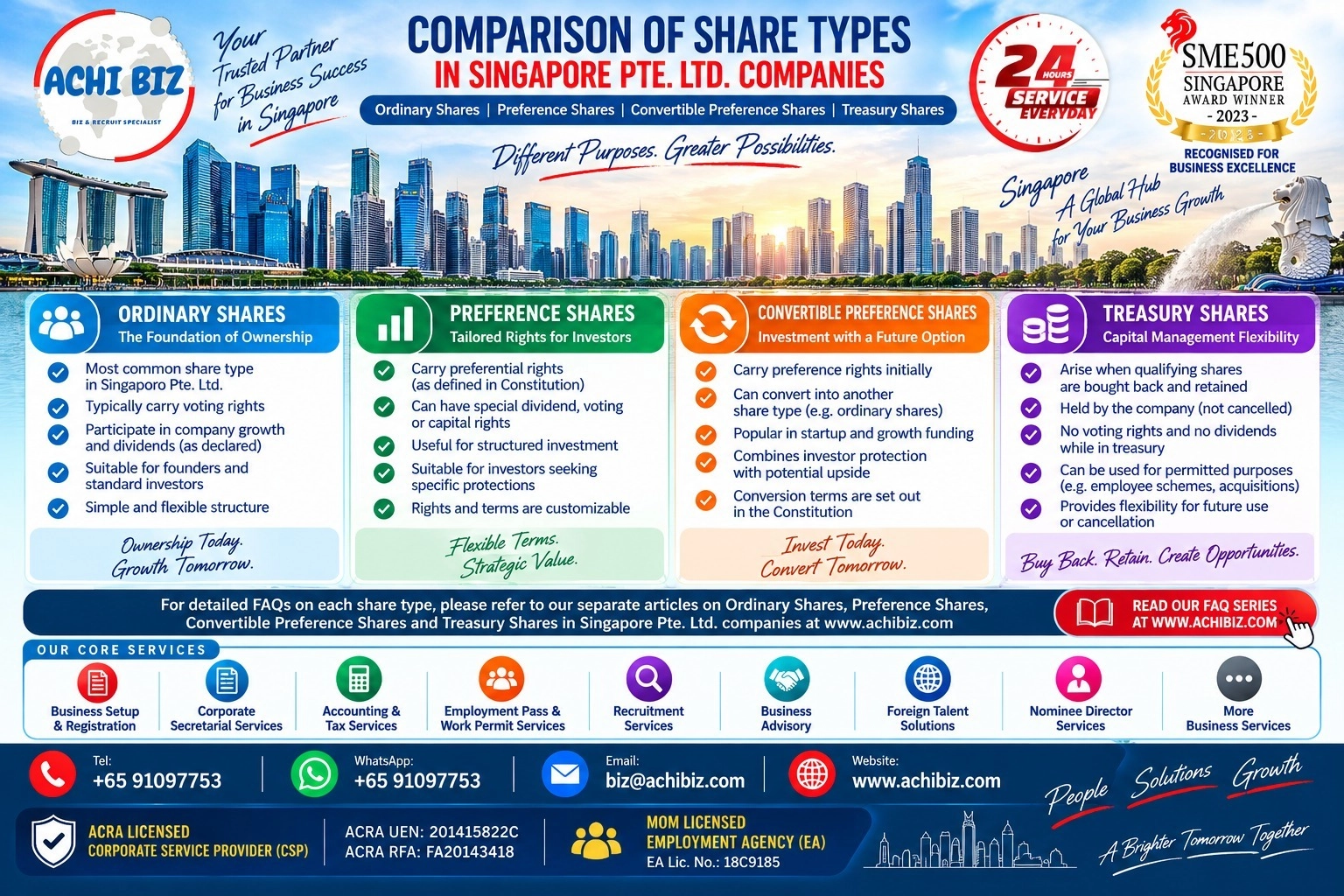
ACRA currently identifies Ordinary Shares, Preference Shares, Redeemable Preference Shares, Convertible Preference Shares and Treasury Shares among the recognised share types. Ordinary Shares are the most common. Preference Shares carry specially structured rights. Convertible Preference Shares combine preference rights with a conversion mechanism. Treasury Shares arise when qualifying shares acquired by the company are retained rather than cancelled.
This article is deliberately a comparison and decision-making guide. We have already covered Ordinary Shares, Preference Shares,Convertible Preference Shares and Treasury Shares in Singapore Pte. Ltd. companies individually in separate detailed ACHI BIZ FAQ articles. Please refer to those articles for the full legal features, procedures, risks and compliance requirements of each share type rather than duplicating them here.
Quick Comparison of the Four Share Types
| Area | Ordinary Shares | Preference Shares | Convertible Preference Shares | Treasury Shares |
|---|---|---|---|---|
| Basic role | Standard ownership equity | Equity with preferential or specially defined rights | Preference equity with a conversion mechanism | Qualifying shares held by the issuing company after acquisition/buyback |
| Typical holder | Shareholder/investor | Shareholder/investor | Shareholder/investor | The company itself while held in treasury |
| Voting | Usually voting rights | Depends on terms; often limited/no voting | Depends on terms before conversion; post-conversion rights depend on resulting class | No voting rights while held in treasury |
| Dividends | Subject to applicable rights and declaration | Usually structured preferentially | Governed by CPS terms before conversion | No dividend payable to company on Treasury Shares |
| Conversion | Not inherently convertible | Not inherently convertible | Conversion is the defining additional feature | Not a conversion instrument |
| Main commercial focus | Ownership and participation | Tailored investor economics/rights | Investment now with agreed future conversion | Capital management after qualifying acquisition/buyback |
| Constitution importance | Determines class rights where applicable | Critical | Critical, including conversion terms | Important, including authority for buyback |
| Typical planning question | Who should own and control the company? | What preferential rights should the investor receive? | What should happen if/when conversion occurs? | Why buy back shares and what should happen to them afterward? |
ACRA notes that Ordinary Shares usually carry voting rights; Preference Shares typically have preferential dividend and capital characteristics; Convertible Preference Shares may convert under agreed terms; and Treasury Shares cannot vote or receive dividends while held by the company.
Frequently Asked Questions – Comparing Share Types in Singapore Pte. Ltd. Companies
What is the most important difference between these four share types?
The most useful distinction is their commercial function.
Ordinary Shares are generally the starting point for ownership.
Preference Shares are used where shareholders or investors require specially structured rights.
Convertible Preference Shares add a future conversion mechanism to a preference-share investment.
Treasury Shares serve a fundamentally different purpose: they arise after qualifying shares have been acquired by the company and retained in treasury rather than cancelled.
Understanding this distinction helps avoid trying to use one share structure to solve a problem for which another structure was designed.
Are all four simply alternative share classes that a company can issue to investors?
No, and this is one of the most important misconceptions to avoid.
Ordinary, Preference and Convertible Preference Shares can form part of an investor-facing share structure.
Treasury Shares are different. They are not simply a fourth investment class that a company creates and allots to an investor. Under the Companies Act framework, qualifying ordinary shares acquired by the company may be held in treasury. ACRA’s allotment guidance also states that Treasury Shares can only be added under the Ordinary class of shares.
This structural difference should be understood before making any comparison.
Which share type is normally the starting point for a newly incorporated Singapore Pte. Ltd. company?
For most straightforward private companies, Ordinary Shares provide the natural starting point.
ACRA describes Ordinary Shares as the most common share type.
A company should generally introduce additional complexity only where there is a genuine commercial reason—for example, a particular investor-rights arrangement, financing structure or future conversion requirement.
For a detailed explanation of Ordinary Shares themselves, refer to our separate Ordinary Shares in Singapore Pte. Ltd. Companies FAQ article.
Does a company need Preference Shares simply because it is raising investment?
No.
Investment does not automatically require Preference Shares.
The company should first identify what the investor actually requires. If the investment terms require preferential economic, capital, voting or other class rights, a properly structured Preference Share class may become relevant.
If no special rights are commercially required, introducing an additional class merely because an investor is involved can create unnecessary complexity.
When does Convertible Preference Shares become more relevant than a straightforward Preference Share structure?
The key question is whether future conversion forms part of the investment bargain.
If the investor is intended to hold preference rights without an agreed conversion mechanism, the commercial analysis differs from an arrangement where the investor is expected or entitled to transition into another share class later.
Convertible Preference Shares become relevant when that transition itself is part of the intended investment structure.
ACRA states that conversion prices for Convertible Preference Shares must be stated in the company’s Constitution.
For the detailed conversion mechanics, refer to our separate Convertible Preference Shares in Singapore Pte. Ltd. Companies FAQ article.
When do Treasury Shares become relevant to the analysis?
Usually when the company is considering buying back its own qualifying shares and deciding whether those shares should be cancelled or retained.
ACRA explains that after a share buyback, a company can cancel the shares or keep qualifying shares as Treasury Shares.
Treasury Shares therefore usually enter the capital-planning discussion at a different stage from the other three categories.
Which share type is most suitable for founders?
There is no universal answer, but founders commonly begin with Ordinary Shares because they provide a straightforward ownership structure.
The more useful questions are:
- Should all founders have identical rights?
- Should voting and economic ownership be aligned?
- Will outside investors be introduced?
- Will future financing require another class?
- Are different founder rights genuinely necessary?
The company should design the rights around the intended governance arrangement rather than selecting a share label first.
Which share type is most suitable for outside investors?
It depends on what the investor is negotiating for.
An investor seeking straightforward equity participation may be comfortable with Ordinary Shares.
An investor requiring specifically negotiated preferential rights may require Preference Shares.
An investor requiring preference rights initially together with an agreed future conversion pathway may consider Convertible Preference Shares.
The appropriate answer comes from the investment terms, not merely from whether the investor is external.
Should an SME automatically create Preference or Convertible Preference Shares in anticipation of future investors?
Usually not without a clear commercial need.
Creating complex share classes before knowing what future investors will require may make the Constitution and cap table unnecessarily complicated.
A future investor may also negotiate terms quite different from those originally anticipated.
For many SMEs, maintaining a straightforward structure until a real transaction requires something more sophisticated can be more practical.
Which structure is generally simpler to administer?
A straightforward Ordinary Share structure will generally involve fewer class-specific terms than a structure containing specially negotiated Preference or Convertible Preference Shares.
Treasury Shares introduce a different kind of administration because the company must properly manage the underlying buyback/acquisition, Treasury Share limits, restrictions and eventual disposal or cancellation.
Therefore, “simple” should be considered in context:
simple ownership structure and simple capital-management process are not necessarily the same thing.
Which share type gives the greatest flexibility?
There is no meaningful single winner because each offers flexibility in a different area.
Ordinary Shares offer simplicity and conventional ownership.
Preference Shares offer flexibility in designing investor rights.
Convertible Preference Shares offer flexibility around future conversion.
Treasury Shares offer flexibility in dealing with qualifying shares already acquired and retained by the company.
The better question is what kind of flexibility does the company actually need?
Which share type is best if voting control is the main concern?
The company should analyse the actual voting rights attached to each relevant class rather than relying on the share name.
ACRA states that Ordinary Shares usually have voting rights, whereas Preference Shares often have no voting rights. However, actual class rights matter. Under section 75 of the Companies Act, the Constitution must specify the voting rights attached to Preference Shares.
Treasury Shares are different: while held in treasury, they have no voting rights.
Can a founder maintain control simply by issuing Preference Shares to investors?
That should never be assumed.
Control depends on much more than the label attached to the investor’s shares. The company must examine:
- voting rights;
- reserved matters;
- class-consent provisions;
- board appointment rights;
- conversion rights;
- future fundraising;
- shareholder agreements; and
- the post-transaction cap table.
An investor can have significant governance influence even where its class does not carry conventional voting rights on every matter.
Which share type provides the strongest dividend rights?
There is no universal answer without reading the actual rights.
Ordinary Shares do not automatically give shareholders a right to demand dividends. ACRA describes Preference Shares as typically receiving fixed dividends and receiving dividends before Ordinary Shareholders.
However, Preference Share dividend rights are governed by their terms, and section 75 requires the Constitution to address whether dividends are cumulative or non-cumulative.
Treasury Shares cannot receive dividends while held by the company.
Which share type should be considered where an investor wants priority economic rights?
That points towards examining a Preference Share structure, because preference rights can be designed around specified economic priorities.
However, the exact priority must be drafted rather than assumed.
Section 75 requires the Constitution to state the rights of Preference Shareholders regarding repayment of capital, participation in surplus assets and profits, dividends, voting, and priority of capital and dividend relative to other shares or preference classes.
Which structure should be considered if the investor wants preferential rights now but potentially a different ownership position later?
That is the type of commercial objective for which Convertible Preference Shares may be considered.
The critical issue is not simply that conversion is possible, but what the company and investor will look like after conversion.
The post-conversion cap table should therefore be modelled before the CPS are issued.
Can Convertible Preference Shares create more future dilution uncertainty than straightforward Ordinary Shares?
Potentially, yes, because the company’s future ownership structure depends on the conversion terms.
A company looking only at today’s issued-share percentages may therefore misunderstand its eventual ownership position.
This is why CPS analysis should include at least:
current cap table → investment → conversion scenario → future financing scenario.
The detailed conversion mechanics are addressed in our separate CPS FAQ.
Do Treasury Shares dilute existing shareholders while they remain in treasury?
This requires a more careful explanation than simply saying “yes” or “no”.
While Treasury Shares are held by the company, they carry no voting rights and cannot receive dividends.
However, the underlying buyback can change the relative position of the remaining shareholders, and a later disposal of Treasury Shares can change the ownership and voting position again.
For decision-making, the company should therefore model both the post-buyback and post-disposal cap tables.
Which share type is most relevant to employee equity incentives?
The answer depends on how the employee equity arrangement is structured.
A company might issue shares under an appropriately designed scheme, while Treasury Shares can also provide an existing pool of shares for certain permitted share-scheme transfers.
The question should therefore be approached as:
What does the employee scheme require, and should the company use existing Treasury Shares or another permitted equity mechanism?
This is more useful than choosing a share type without first designing the scheme.
Which share type is more relevant for acquisition consideration?
Treasury Shares may become relevant where the company already holds them and intends to use them for a permitted acquisition transaction.
Under the Companies Act, a private company may deal with Treasury Shares in the ways permitted by section 76K, including specified transfers as acquisition consideration.
Whether that approach is commercially preferable should be analysed for the actual transaction.
Which structure is better for a company expecting several future investment rounds?
The company should focus on capital-structure scalability rather than selecting one share type in isolation.
Questions to model include:
- Will new investor classes be introduced?
- Will existing Preference Shares retain their rights?
- Will CPS convert during a later financing?
- Will conversion affect founders disproportionately?
- Are there pre-emption or class-consent rights?
- How will the fully diluted cap table look?
- Will Treasury Shares be available for future permitted uses?
A structure that works for the first investment may become difficult during the third or fourth round if these interactions were not considered.
Can a company have Ordinary Shares, Preference Shares and Convertible Preference Shares at the same time?
Potentially, yes, provided the company’s Constitution, class rights, approvals and statutory requirements support the structure.
ACRA recognises that companies can have different share classes.
The challenge is usually not whether several classes can exist, but whether their respective rights interact coherently.
Can the same company also hold Treasury Shares while those other classes exist?
Potentially, yes, subject to the Treasury Share statutory framework.
Where a company has different classes, section 76I imposes the Treasury Share maximum by reference to the relevant class.
Importantly, the Treasury Share framework under section 76H concerns qualifying ordinary shares or stocks acquired by the company.
Does having more share classes automatically make a company more sophisticated?
No.
A complicated capital structure is not necessarily a better capital structure.
Every additional class can introduce:
- additional constitutional drafting;
- class-rights considerations;
- more complicated resolutions;
- investor negotiations;
- cap-table complexity;
- accounting considerations; and
- greater risk of filing or implementation errors.
The best structure is generally the simplest structure that properly achieves the company’s genuine commercial objectives.
Can too many share classes create problems during due diligence?
Yes.
Investors, banks, buyers and advisers may need to understand:
- what each class is entitled to;
- whether all issues were validly approved;
- whether the Constitution accurately records the rights;
- whether ACRA filings are consistent;
- whether conversions were properly implemented;
- whether class rights were varied correctly; and
- what the fully diluted ownership actually is.
A poorly documented multi-class structure can therefore create unnecessary work during fundraising or an eventual sale.
Should a company create several share classes merely for different shareholders?
Not necessarily.
Different shareholders do not automatically require different share classes.
Separate classes are most useful where there is a genuine reason for their legal rights to differ.
If the intended rights are identical, multiplying share classes may add administration without providing a meaningful commercial benefit.
Can two groups of Ordinary Shares have different rights?
ACRA states that companies can create different classes of Ordinary Shares, such as A and B shares, with different rights for each class.
Therefore, a company should not assume that every governance objective automatically requires Preference Shares.
The appropriate drafting depends on what rights the company actually wants to differentiate.
Should a company use Preference Shares merely to give an investor a different dividend arrangement?
Potentially, but the company should consider the entire package of rights rather than one feature.
Once a Preference Share class is introduced, section 75 requires the Constitution to address several areas, including capital repayment, surplus participation, dividends, voting and priority.
A Preference Share class should therefore be designed comprehensively.
Should a company use Convertible Preference Shares merely because conversion sounds attractive?
No.
Conversion adds value only where there is a clear reason for the investor’s shareholding to change later.
Without a defined commercial objective, conversion terms may simply create future uncertainty around ownership, voting and valuation.
Should a company buy back shares merely to create Treasury Shares?
Generally, that should not be the starting objective.
The board should first establish a proper commercial reason for the buyback itself.
ACRA notes that companies may buy back shares where they have excess capital not needed for operations, but a buyback has financial consequences and should be evaluated on its own merits.
Treasury treatment is then a decision about what happens to qualifying repurchased shares.
Which share type is most suitable when a shareholder wants to exit?
The answer depends on who is acquiring the shareholder’s interest.
If another person is buying the shares, that may be a share transfer.
If the company itself is acquiring qualifying shares, the statutory share-buyback framework may become relevant, after which qualifying shares may be cancelled or held as Treasury Shares.
The existing share class alone does not determine the correct exit mechanism.
Can an Ordinary Share later become another class of share?
Singapore law provides for conversion of shares, subject to the Companies Act and the company’s Constitution.
ACRA states that share conversion changes existing shares into another class and that companies must notify ACRA of a conversion.
However, the statutory restrictions and class-rights implications should be checked before relying on conversion as a future restructuring solution.
Is converting a share the same as selling it?
No.
A conversion changes the class or type of an existing share.
A transfer changes the holder of an existing share.
A buyback involves the company acquiring its own shares.
These are separate corporate transactions and should not be treated as interchangeable merely because all of them change the cap table. ACRA maintains separate filing processes for these transactions.
Is converting CPS the same as moving shares into treasury?
No.
CPS conversion concerns changing the share class according to the applicable conversion framework.
Treasury treatment arises from the company acquiring qualifying shares and retaining them under the Treasury Share framework.
The commercial purpose and legal process are fundamentally different.
Is cancelling Treasury Shares the same as converting them?
No.
Cancellation permanently removes the relevant Treasury Shares.
Conversion changes existing shares from one class into another.
The two transactions should not be confused when planning share-capital changes or making Bizfile filings.
Which of the four share types can vote?
There is no single answer without considering the applicable rights.
Ordinary Shares: usually voting.
Preference Shares: depends on their terms.
Convertible Preference Shares: depends on their terms before conversion and the resulting class after conversion.
Treasury Shares: cannot vote while held by the company.
ACRA’s current guidance reflects these distinctions, while section 76J expressly removes voting rights from Treasury Shares.
Which of the four can receive dividends?
Again, the rights and status matter.
Ordinary and preference-based shareholder classes may participate according to their respective rights and lawful dividend declarations.
Treasury Shares are the clear exception in this comparison: no dividend may be paid to the company in respect of Treasury Shares.
Which share type offers the strongest protection against dilution?
No share type automatically provides complete dilution protection.
Dilution protection depends on the overall legal structure, including:
- pre-emption rights;
- class rights;
- consent rights;
- conversion adjustments;
- Constitution;
- shareholders’ agreement; and
- terms of future issues.
A shareholder should therefore not assume that holding Preference or Convertible Preference Shares alone prevents dilution.
Which structure gives an investor the clearest exit route?
A share type alone does not guarantee an exit.
Exit can depend on:
- transfer rights;
- buyer availability;
- contractual exit provisions;
- company buyback arrangements;
- redemption rights where separately applicable;
- conversion rights;
- drag/tag provisions; and
- an eventual business sale.
The investor’s intended exit should be considered during structuring rather than assumed from the class name.
Which structure is best if the company expects an eventual business sale?
There is no universal “sale-ready” share type.
A potential buyer will normally examine the entire cap table and rights structure.
A company expecting a future sale should therefore aim for clarity around:
- ownership;
- voting rights;
- class rights;
- conversion rights;
- outstanding investor rights;
- Treasury Shares;
- transfer restrictions; and
- transaction approvals.
A clean and well-documented structure can be more valuable than unnecessary sophistication.
Which structure is best for a joint venture company?
That depends on the joint venture’s governance arrangement.
Rather than selecting a share type first, the parties should determine:
- ownership percentages;
- board representation;
- voting thresholds;
- reserved matters;
- funding obligations;
- dividend policy;
- deadlock procedures; and
- exit arrangements.
Only then should the appropriate share classes be designed.
Which share type is best for a family-owned Pte. Ltd. company?
The same principle applies.
A family company should first identify what it is trying to achieve—equal ownership, different voting control, succession, income participation, future transfer arrangements or another objective.
Creating complex share classes without a defined succession or governance plan may make future family transitions more difficult rather than easier.
Which share type is best for an employee who is becoming a shareholder?
The company should consider the employee’s intended economic and governance position, vesting or incentive arrangement, transfer restrictions and eventual exit.
The answer may differ considerably between a senior executive becoming a long-term shareholder and an employee participating through an incentive scheme.
Treasury Shares may also be relevant where an existing Treasury Share pool is lawfully used for a qualifying share scheme.
How should a startup choose among Ordinary, Preference and Convertible Preference Shares when raising capital?
A startup should start with the investor deal rather than the terminology.
Ask:
What amount is being invested?
What rights does the investor require today?
Does the investor require economic priority?
What voting or consent rights are required?
Is future conversion intended?
What will the founders own after the transaction and after any conversion?
What happens in the next funding round?
Once those questions are answered, the appropriate share structure becomes much clearer.
How should an established SME approach the same decision?
An established SME should additionally consider the effect on its existing operating history and ownership structure.
Introducing a new class after many years of straightforward Ordinary Share ownership can affect:
- existing shareholder expectations;
- voting dynamics;
- dividend arrangements;
- succession planning;
- banking or investment discussions; and
- future sale negotiations.
The company should therefore model both the legal and relationship consequences.
Can different share types affect company valuation?
They can affect how investors interpret value.
A simple headline valuation does not necessarily explain the economic value of each class where different rights exist.
Preference rights, conversion terms and other contractual rights can influence how different investors evaluate their economic position.
Accordingly, percentage ownership alone may not tell the full story.
Is a shareholder with 20% of one class economically equivalent to someone with 20% of another class?
Not necessarily.
The percentage is only one part of the analysis.
The rights attached to those shares may differ regarding:
- voting;
- dividends;
- capital;
- priority;
- conversion; and
- other negotiated protections.
This is why cap-table analysis should be combined with a review of the actual class rights.
Does having more shares always mean having more control?
No.
Control depends on voting rights and governance arrangements, not merely the number of shares shown next to a shareholder’s name.
A holder of fewer shares may potentially have significant contractual or class-specific rights, while Treasury Shares held by the company have no voting rights at all.
Does paid-up capital determine which share type is better?
No.
Paid-up capital tells you how much of the issued share capital has actually been paid. It does not determine the appropriate rights structure.
ACRA distinguishes issued shares from paid-up shares and explains that shares may be fully or partially paid.
The share-class decision should instead reflect ownership and investment objectives.
Does the highest-value investor necessarily need Preference Shares?
No.
Investment amount alone does not determine the appropriate share class.
A substantial investor may accept Ordinary Shares, while a smaller strategic investor may negotiate specific rights requiring another structure.
The legal rights agreed between the parties are more important than the investment amount alone.
Should the company consider its Constitution before choosing among these structures?
Absolutely.
The Constitution is central to the company’s share structure.
It becomes particularly important where the company intends to create Preference Shares or Convertible Preference Shares. Section 75 requires specified Preference Share rights to be set out in the Constitution.
ACRA also instructs companies considering share conversion to check whether their Constitution permits it.
Can a shareholders’ agreement replace the Constitution for share-class rights?
The documents can work together, but a private agreement should not be assumed to replace statutory requirements concerning the Constitution.
This is particularly important for Preference Shares because section 75 expressly requires specified rights to be set out in the Constitution.
Companies should ensure that the Constitution, shareholders’ agreement and investment documents are consistent.
Why should directors consider all four structures together even if only one transaction is happening today?
Because today’s decision can affect tomorrow’s transaction.
For example:
Ordinary Shares today → Preference investment later → CPS conversion after another financing → future buyback → Treasury Shares.
A company does not need to implement all these structures, but understanding how future capital transactions may interact can prevent avoidable restructuring later.
What is the biggest mistake companies make when choosing a share structure?
A common conceptual mistake is choosing the label before defining the objective.
Instead of asking:
“Should we issue Preference Shares?”
ask:
“What rights should this investor have?”
Instead of:
“Should we issue Convertible Preference Shares?”
ask:
“Why should this investor convert, when should conversion happen, and what should ownership look like afterward?”
Instead of:
“Should we have Treasury Shares?”
ask:
“Why is the company buying back shares, and what does it intend to do with the acquired shares?”
The second set of questions usually produces better corporate decisions.
What is the biggest mistake when analysing voting control?
Looking only at current ownership percentages.
A proper control analysis should consider:
- votes per class;
- reserved matters;
- class consent;
- board appointment rights;
- future allotments;
- conversion scenarios;
- Treasury Shares;
- pre-emption rights; and
- shareholder agreements.
The current cap table is only the starting point.
What is the biggest mistake when analysing dilution?
Looking only at the number of shares being issued today.
The company should consider the potential future position after:
- conversion;
- employee equity issues;
- additional fundraising;
- exercise of outstanding rights; and
- disposal of Treasury Shares.
A scenario-based cap table is therefore much more informative.
Should a company maintain both an issued-share and a fully diluted cap table?
Where the company has convertible or other potentially dilutive instruments, this is good practice.
The issued-share table shows the present legal shareholding.
A properly prepared fully diluted scenario helps management and investors understand what ownership could look like if relevant conversion or other rights are exercised.
For Treasury Shares, separate identification is also useful because their voting and economic treatment while held by the company differs from shares held externally.
How should a company compare the cost of maintaining different share structures?
The company should consider more than incorporation or filing fees.
Complexity can generate costs through:
- Constitution amendments;
- legal drafting;
- shareholders’ agreements;
- corporate-secretarial work;
- accounting treatment;
- valuations;
- investor negotiations;
- class approvals;
- cap-table management; and
- future restructuring.
A structure that appears flexible today can become expensive if it was unnecessarily complicated.
Which share structure is least likely to create future disputes?
No structure can eliminate shareholder disputes.
However, clarity significantly reduces risk.
The company should ensure that:
- rights are clearly drafted;
- Constitution and agreements are consistent;
- shareholders understand the terms;
- approvals are properly documented;
- cap-table consequences are modelled;
- ACRA filings are accurate; and
- future events such as conversion or disposal are anticipated.
The quality of the documentation often matters more than the name of the share class.
Should directors consider their duties when deciding between these share structures?
Yes.
Share issues, conversions, buybacks and Treasury Share disposals can materially affect ownership, control and shareholder economics.
Directors should therefore consider the company’s interests, the purpose of the transaction, applicable statutory requirements and their duties rather than treating share restructuring as a purely administrative exercise.
Can an incorrect share transaction be difficult to rectify later?
Yes.
ACRA expressly warns that share transactions are complex and filing errors can be costly. Where an error cannot be corrected through a Notice of Error, a company may need an Order of Court to amend it.
This is one reason to establish the legal transaction first and file it second—not the other way around.
Should the company choose a share type based on what is easiest to file with ACRA?
No.
Bizfile records the corporate transaction; it should not determine the commercial structure.
The correct sequence is:
Commercial objective → legal/share structure → Constitution and approvals → transaction documentation → ACRA filing.
Starting with the available filing options can lead to the wrong transaction being implemented.
What should founders discuss before deciding on a share structure?
A useful strategic discussion should cover:
- Who should own the company today?
- Who should control voting?
- Will investors be introduced?
- What special rights, if any, will investors require?
- Is future conversion contemplated?
- What will ownership look like after conversion?
- Are employee shares expected?
- Is future fundraising likely?
- Could the company undertake a buyback later?
- Is there a likely founder or shareholder exit?
- How should succession be handled?
- What happens if the company is sold?
- Can the company administer the proposed structure properly?
Only after answering these questions should the share-class architecture be finalised.
What should investors analyse beyond the name of the shares being offered?
An investor should understand the actual legal and economic package, including:
- rights attached to the class;
- voting;
- dividends;
- capital priority;
- conversion rights;
- dilution exposure;
- pre-emption rights;
- class protections;
- transfer restrictions;
- shareholder agreement;
- Constitution;
- current cap table; and
- fully diluted cap table.
“Preference” or “convertible” in the share name is not a substitute for reading the terms.
What should an existing shareholder analyse before approving a new share class?
The shareholder should consider not only what the new investor receives, but what changes for existing shareholders.
Relevant questions include:
- Will existing voting percentages change?
- Will dividend economics change?
- Will another class rank ahead?
- Can the new class convert later?
- What happens after conversion?
- Are existing class rights being varied?
- Will future fundraising become more complicated?
This turns the decision from a procedural vote into an informed ownership decision.
How can a company decide between a simple and sophisticated share structure?
A useful principle is:
Use as much complexity as the transaction requires, but no more.
A simple company with straightforward ownership may need only Ordinary Shares.
A negotiated investment may justify Preference Shares.
A transaction requiring a future equity transition may justify Convertible Preference Shares.
A company that has lawfully acquired qualifying shares may decide that retaining them as Treasury Shares provides useful future flexibility.
The structure should follow the business need.
What is a practical decision framework for comparing all four?
Think about the company’s objective in four stages:
Ownership:
Who should own the company and exercise ordinary shareholder rights?
Investment:
Does an investor require specially structured economic or governance rights?
Future transition:
Does the investment require an agreed mechanism for the investor’s shares to convert later?
Capital management:
Has the company acquired qualifying shares itself, and should those shares be cancelled or retained for permitted future use?
This framework usually makes the distinction among the four much easier to understand.
When should professional advice be obtained?
Professional assistance becomes particularly important where the proposed structure involves:
- multiple share classes;
- substantial investment;
- complex preference rights;
- conversion formulas;
- founder dilution;
- changes in control;
- shareholder disputes;
- selective buybacks;
- Treasury Shares;
- employee equity;
- acquisition consideration;
- tax or accounting implications; or
- amendments to existing class rights.
Corporate-secretarial assistance can address the company-law and ACRA implementation aspects, while specialised legal, tax, accounting or valuation advice may be required depending on the transaction.
Which Share Type Should a Singapore Pte. Ltd. Company Choose?
There is no universally superior share type.
A company seeking a straightforward ownership structure may find Ordinary Shares sufficient.
Where an investor requires specially defined economic or governance rights, Preference Shares may be considered.
Where those preference rights are intended to operate initially but an agreed future conversion is commercially important, Convertible Preference Shares may become relevant.
Where the company itself has acquired qualifying shares and wants to retain them rather than cancel them, Treasury Shares serve a different capital-management purpose.
The most important principle is therefore:
Do not start by choosing the share type. Start by defining the commercial objective, shareholder rights, future ownership outcome and capital strategy. Then choose the structure that properly supports them.
For detailed legal features and individual FAQs, please refer to our separate ACHI BIZ articles on:
- Ordinary Shares in Singapore Pte. Ltd. Companies
- Preference Shares in Singapore Pte. Ltd. Companies
- Convertible Preference Shares in Singapore Pte. Ltd. Companies
- Treasury Shares in Singapore Pte. Ltd. Companies
This comparison article is intended to help business owners, founders and investors understand how to choose between the structures, without repeating the detailed material already covered in those individual guides.
How ACHI BIZ Can Assist
ACHI BIZ can assist Singapore Pte. Ltd. companies with the corporate-secretarial and ACRA compliance aspects of share matters, including share allotments, changes to share structures, corporate resolutions, shareholder records, Constitution-related corporate actions and applicable Bizfile filings.
Where the proposed structure involves specialised legal drafting, investment agreements, valuation, tax or complex accounting treatment, the appropriate professional advisers should also be engaged.
Related Pages
Why Do Singapore Pte Ltd Companies Commonly Issue Ordinary Shares? – FAQ Guide
Ordinary Shares vs Preference Shares in Pte Ltd Companies – FAQ Guide
#achibiz